
How to Store Shrink Film: Rolls, Shelf Life, Handling
What the 10–30°C, 12-month storage window actually protects, how to stand rolls so they don't flat-spot, and why film has to acclimate before it reaches the line.
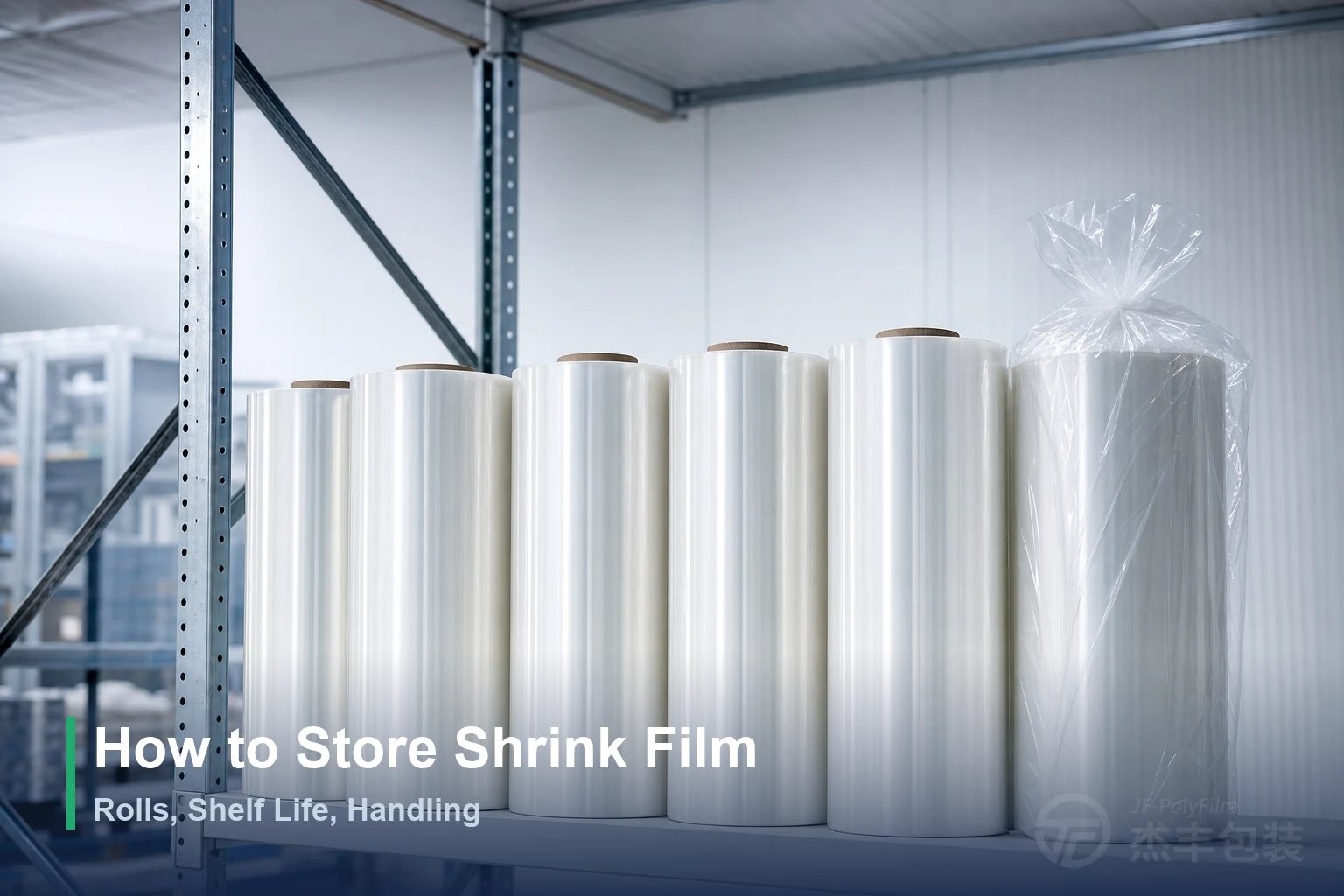
Store PETG shrink sleeve film cool and dry — around 10 to 30°C, sealed in its original packaging and out of direct sun and heat — and it holds its shrink performance for roughly a 12-month shelf life. Storage is a performance question, not just housekeeping, because the same film that shrinks on a warm tunnel will slowly shrink in a warm store.
Key takeaways
- PETG is an amorphous, heat-sensitive film: warm it toward its glass-transition temperature and it begins to relax, pre-shrink, and block, so where and how it is stored directly affects whether it still performs.
- The recommended window is 10 to 30°C — ideally the middle of that band, near 15 to 25°C — with low humidity, protection from direct sun and UV, and the original sealed packaging left intact until use; shelf life under those conditions is about 12 months.
- Rolls should stand on their ends or sit in dedicated racks, never lie flat or stacked under load, because flat spots, core crush, and edge damage ruin how the film unwinds and how the sleeve registers.
- Film taken from a cold or cool store must acclimate, still sealed, to line temperature before opening, or condensation forms on the cold film and disrupts shrinking, sealing, and print.
- First-in, first-out rotation, plus a batch-coded roll label and Certificate of Analysis on every JFPolyFilm batch, keeps stock inside its 12-month life and fully traceable back to the lot that made it.
How to store shrink film: four conditions that keep it in spec
Four conditions keep PETG shrink film in specification: a cool, stable temperature of 10 to 30°C, low humidity, protection from direct sun and UV, and the original sealed packaging left intact until the film is used. Each one guards against a different way the film can drift out of spec before it reaches the shrink sleeve line.
Temperature comes first. PETG is happiest stored cool and steady, in the 10 to 30°C band and ideally toward its middle, around 15 to 25°C. What it dislikes is heat and swing: a spot next to a radiator, a sun-facing wall, or a loading door that cycles hot and cold each day works the film harder than a plain, stable store, and warmth close to the material’s softening range starts the film shrinking early.
Humidity is the second condition, and the reliable rule is simply to keep the film dry and sealed. Relative-humidity targets are not standardized across the industry, and sources differ on the exact band, so rather than chase a set point, keep the rolls in a low-humidity space with their moisture-barrier packaging closed. Film that takes up moisture loses clarity, seals and sleeves less cleanly, and turns more brittle.
Light and UV are the third. Direct sunlight and strong UV break the polymer chains over time, which shows up as yellowing, lost clarity, and a gradual fall in shrink and strength. Keeping rolls in their original, opaque packaging and away from windows and strong UV lighting is enough to keep this at bay.
The packaging itself is the fourth condition, and the simplest to honor: leave it on. The original wrap shields the film from moisture, dust, and light all at once, so a roll opened only when it reaches the line has spent its whole shelf life protected.
| Condition | Recommended | Why it matters | Keep it away from |
|---|---|---|---|
| Temperature | 10–30°C, ideally 15–25°C, stable | Warmth near the softening range starts premature shrink; swings stress the film | Radiators, sun-facing walls, loading doors, tunnels |
| Humidity | Low; keep dry and sealed | Moisture uptake dulls clarity and hurts sealing and sleeving | Damp floors, unheated corners, condensation zones |
| Light / UV | Dark, in original packaging | UV breaks polymer chains — yellowing, lost clarity and shrink | Direct sun, windows, strong UV lighting |
| Packaging | Original wrap intact until use | Barrier against moisture, dust, and light in one | Open storage on unwrapped rolls |
Shelf life, and how the film ages
In its original packaging under recommended conditions, PETG shrink film keeps its shrink performance for about 12 months, and outside that window it ages faster because three mechanisms drive the decline: heat, moisture, and UV. None of them makes the film fail overnight; each slowly moves it away from the shrink rate and dimensions it left the plant with.
Heat is the strongest driver. Because PETG is amorphous and heat-sensitive, warmth toward its glass-transition temperature increases how freely the molecular chains move, and a film that can move can relax. That relaxation is premature shrinkage: the roll gives back a little of the stored orientation it is supposed to release only in the tunnel, so it can arrive short of its rated shrink, softer, and tacky enough for wound layers to block, or stick together. The full molecular picture — why an oriented film holds shrink energy until heat unlocks the chains — belongs to how PETG shrink film works; for storage, the point is that anything warming the film toward that release adds age.
Moisture and UV finish the list. Absorbed moisture clouds the film, weakens seals and sleeving, and, on the print side, slows ink drying and hurts adhesion. UV, as above, breaks chains and leaves the film yellowed, hazy, and brittle with a lower shrink rate. Under poor conditions — hot, damp, or sun-struck — these run well inside the 12-month figure, which is exactly why rotating stock first-in, first-out matters: it keeps the oldest rolls moving before their window closes. A roll near the end of its window is not automatically scrap, though: a short shrink trial on a sample says whether it still hits its rated draw before it goes onto a production run, which is a cheaper check than discovering the drift on the line.
What goes wrong in storage — and how to prevent it
Most storage faults trace back to one of a short list of causes, and each has a matching prevention. Reading the failure and the fix side by side is the fastest way to audit a store, because it turns “keep it cool and dry” into specific things to check.
| Storage fault | Cause | Prevention |
|---|---|---|
| Premature shrink / dimensional drift | Warmth near the softening range relaxes stored orientation | Hold 10–30°C, away from heat and sun |
| Blocking (wound layers stuck together) | Heat plus humidity softens and tacks the surface | Keep cool, dry, and sealed |
| Moisture damage (haze, poor seal, weak sleeving, brittleness) | Film takes up humidity | Low-humidity store, original packaging closed |
| Edge crush / core crush and ovalization | Flat stacking or heavy loads on the roll | Stand upright or rack; do not stack |
| Flat spots | Roll resting on its circumference under weight | Store on the end, or suspend the roll |
| Dust and contamination | Unwrapped rolls in an open store | Leave the original wrap on until use |
Two things are worth separating out. First, faults that appear at the tunnel rather than in the store — wrinkling, scorching, an open base skirt — usually trace back to the line, not the warehouse, and are worked through in solving PETG shrink film problems; the table above covers only the failures storage itself can cause or prevent. Second, the physical faults — flat spots and core crush — are common enough to deserve their own handling rules, which the next section sets out.
How to stack and support the rolls
Store rolls standing on their ends or held in dedicated roll racks, never lying flat under their own weight or stacked on top of one another. The single principle behind every roll-handling rule is to keep the roll from carrying a load that deforms it, because a deformed roll runs badly long after storage has ended.
The reason is geometry. A cylindrical roll laid on its side rests its whole weight on a narrow line of contact, so the pressure at that line is high and, given time, it presses a flat spot into the circumference. Stack rolls, and the lower ones also take the weight of everything above, which crushes or ovals the core. Both faults matter downstream: a flat-spotted roll unwinds unevenly, and a crushed or oval core disturbs unwind tension and pulls the sleeve out of register on the applicator — the film can be perfectly in spec and still run poorly because the roll lost its shape in the rack.
Industry practice varies on the exact method — some stores stand rolls on their ends, others suspend them on a shaft or hold them in purpose-built racks — and any of these is sound as long as the roll is never left resting on its circumference under load. Keep the rolls off the floor, away from heat sources and windows, and resist the temptation to stack for space; the floor space saved is rarely worth the flat spots and crushed cores it buys. How much film is on each roll and how heavy it is depends partly on the gauge, but the support principle is the same across the 30 to 60 μm range.
Moving film from the store to the line
Film taken from a cold or cool store should be left sealed and allowed to reach line temperature before the packaging is opened, so that no condensation forms on the cold film. This is the handling step most easily skipped and the one that quietly spoils an otherwise good roll.
The mechanism is straightforward. A cold film surface brought into a warm, humid workroom draws condensation the same way a cold glass sweats, and that thin film of surface moisture interferes with heat shrinking and sealing and leaves print and sleeving defects. Keeping the roll in its sealed original packaging while it warms lets it reach room temperature without wetting the film. How long that takes depends on the temperature gap and the roll diameter, so there is no fixed number to quote — the practical test is to let the roll sit, still wrapped, until it is no longer cold to the touch, then open it. Stock held at normal warehouse temperature needs no special re-warming; the step matters most when film has been kept genuinely cold.
Alongside this, two habits keep the line fed cleanly. Rotate stock first-in, first-out so the oldest rolls are used first and none drifts past its shelf life, and handle the cores gently — a dropped or knocked core carries the same crush and ovalization risk as a badly stacked roll. When a roll is only partly used, re-wrap the remainder and return it to the store rather than leaving it open on the line, so the unused film keeps the same moisture, dust, and light protection as a fresh roll. Once the film is at temperature and loaded on the applicator, dialing in the heat that actually shrinks it is a separate task, set out in PETG shrink tunnel temperature.
How the film is packed and shipped
Film should arrive ready to store, and that starts with how it leaves the plant: wound jointless onto its core, sealed in moisture-barrier packaging, and labeled with a batch code, so its 12-month shelf-life clock begins on clean, protected stock. A roll that ships well is far easier to store well.
JFPolyFilm’s clear PETG carries a transverse shrink of 75% or above across the SH650, SH750, and SH800 grades, in thicknesses from 30 to 60 μm and widths from 200 to 2000 mm, and every batch is sampled over at least five metres for thickness, shrink rate, haze, and tensile strength before it ships with a Certificate of Analysis. Two of those shipping details protect the film in storage specifically: the jointless winding means there are no splices to cause a bad unwind after months on the rack, and the batch-coded roll label ties each roll back to its lot, so if anything reads out of spec it traces cleanly to the batch that made it — the backbone of any first-in, first-out system. The film prints directly without corona pre-treatment and is supplied against GRS, REACH, and RoHS.
Kept at 10 to 30°C in that sealed packaging, the film we ship holds its rated shrink for its full 12-month life. For a container and a line already defined, JFPolyFilm’s clear PETG shrink film can be matched to the grade and gauge the job needs, wound and labeled to store and run cleanly from the first roll to the last.
Frequently Asked Questions
How should PETG shrink film be stored?
What is the shelf life of shrink film?
Can shrink film be stored in a cold room and used straight away?
Why should shrink film rolls be stored standing up?
Does shrink film go bad if it gets too warm?
Related Articles
Shrink Film Test Methods: How Specs Are Measured
Every figure on a shrink film datasheet or COA traces back to a standard method. See which ASTM and ISO tests measure shrinkage, tensile, haze, and gauge, and how to read the report.
How to Choose Shrink Film Thickness: 30-60 μm
Gauge and shrink rate are two separate specs. See how container size, durability, the sleeving line, and downgauging set a PETG sleeve's thickness across the 30-60 μm range.
Need Expert Advice on Shrink Film?
Our technical team can help you choose the right film for your application.
Contact Us