
How to Choose Shrink Film Thickness: 30-60 μm
Gauge and shrink rate are two separate specs. See how container size, durability, the sleeving line, and downgauging set a PETG sleeve's thickness across the 30-60 μm range.
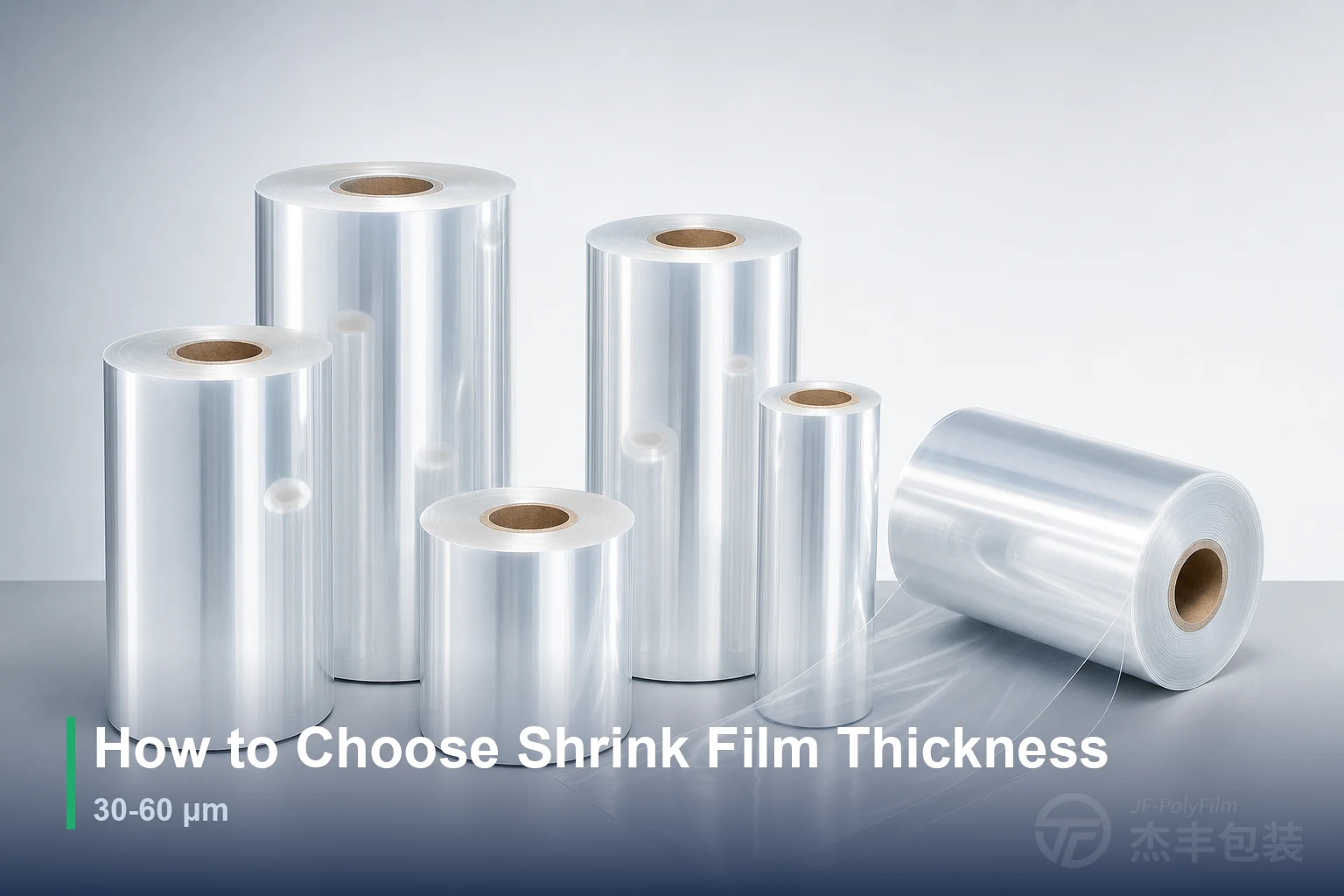
Shrink film thickness — the gauge — is how thick the film web is in microns, and for PETG shrink sleeves it runs about 30 to 60 μm; the right gauge follows from container size, durability, and the sleeving line, not from how far the film shrinks.
Key takeaways
- PETG shrink sleeve film runs about 30 to 60 μm, with 40 and 50 μm the most common stock gauges; the wider sleeve-label industry spans roughly 30 to 70 μm, thinner for lightweighted bottles and cost-driven runs, thicker for large-diameter or high-stiffness packs.
- Thickness and shrink rate are independent specs: gauge (μm) says how much material is in the web, while transverse shrink — about 75 to 80 percent for PETG — says how far the film draws in. Neither predicts the other.
- Four factors set the gauge: container size and sleeve height, the stiffness and durability the pack needs, the sleeving line’s operating window, and the material yield traded against robustness.
- Downgauging — thinner film at equal performance — is the industry direction for source reduction and cost, but every application has a floor below which stiffness and machine handling suffer.
- PETG’s higher tensile strength and impact toughness let it run thinner than PVC at equal strength, though PVC stays stiffer — one reason polyester supports downgauging.
What film thickness means, in microns and gauge
Film thickness, or gauge, is the depth of the film web measured in microns (μm), and for PETG shrink sleeves it sits in a working range of about 30 to 60 μm, clustering around 40 and 50 μm on most jobs. Stock is usually offered in steps — 35, 40, 45, 50, and 55 μm — while the wider sleeve-label industry runs roughly 30 to 70 μm: the thin end for lightweighted bottles and cost-driven runs, the thick end for large-diameter or high-stiffness packs. JFPolyFilm’s clear PETG covers the full 30-60 μm band at widths to 2000 mm, so a single grade can be specified thick or thin without switching material.
Buyers used to imperial units will see the same film quoted in mil or gauge, and the conversion is a fixed physical ratio rather than a performance figure: one mil equals 25.4 μm, and 100 gauge equals one mil.
| Thickness | In mil | In gauge |
|---|---|---|
| 40 μm | 1.57 mil | 157 gauge |
| 50 μm | 1.97 mil | 197 gauge |
| 60 μm | 2.36 mil | 236 gauge |
Gauge is only one axis of a shrink-film spec, and it is easy to read it as if it carried the film’s shrink performance too. It does not — which is where most thickness mistakes begin.
Thickness is not shrink rate: two independent specs
The most common mix-up in specifying a sleeve is treating a thicker film as a higher-shrink film; gauge and shrink rate are independent specifications, each chosen on its own terms. Thickness (μm) describes how much material is in the web. Shrink rate describes how far the film contracts sideways in the heat tunnel — for PETG, a transverse draw of about 75 to 80 percent. One says how thick, the other says how far it pulls in, and neither predicts the other.
That independence is real in the product table, not just in principle. The same shrink grade is manufactured in several thicknesses, and a single thickness is available across different shrink grades, so a film can be thin and high-shrink at the same time, or thick and moderate-shrink. A 40 μm film can be built to a high-shrink grade drawing around 78 percent, while a 55 μm film can be built to a lower-shrink grade — the gauge is silent on which. Thickness never sets the ceiling on shrink, and a heavier gauge buys no extra contraction. The confusion is easy to fall into because both numbers sit side by side on the same technical sheet, and a heavier film simply feels like it should do more — but on the shelf the two behave nothing alike.
The practical consequence is that the two decisions run on separate tracks. Choosing the shrink tier — whether a job needs 65, 75, or 80 percent — is driven by the depth of the container’s curves and is worked through in how to choose PETG shrink rate; that question is settled first, on its own. Choosing the gauge, the subject here, is driven by size, handling, and the line, and it takes the shrink grade as already fixed. Why a heated film contracts at all is a separate topic again, covered in how PETG shrink film works. Keeping the two specs apart is what stops a buyer from over-ordering a heavy film in the hope of more shrink, or reaching for a thin one and finding it short on stiffness.
The four factors that actually set the gauge
With the shrink grade fixed, four factors decide how thick the film should be: the size of the container and the sleeve, the stiffness and durability the pack needs, the sleeving line’s operating window, and the material yield the buyer is willing to trade against robustness. None of them is shrink rate.
Container size and sleeve height come first. A large-diameter bottle or a tall, full-body shrink sleeve carries more unsupported film to hold square as it opens from the flattened tube and drops over the container, so it leans thicker to stay open, feed cleanly, and cover evenly without sagging. A small bottle or a short band asks far less and runs comfortably thinner.
Stiffness and durability follow. A thicker film is tougher — it resists scuffing, creasing, and tearing through sleeving, shipping, and time on the shelf — while a thinner film saves material but is more delicate and more prone to wrinkling or splitting if the pack is handled hard. The heavier the supply chain and the more shelf presence a brand wants, the more that argues for gauge.
The sleeving line sets a third limit. Modern shrink-sleeve applicators run within a thickness window: film that is too thin is harder to open, place, and register cleanly, while film that is too thick raises sleeving resistance and the energy needed to draw it down. A gauge that sits comfortably inside the line’s window matters as much as any datasheet number, because a film that will not feed reliably never reaches the tunnel.
Yield and cost pull the other way. Thinner film yields more sleeve area per unit weight, so each sleeve uses less material — a genuine, ongoing saving that also lightens the pack. That pressure toward thinner is real, but it has a floor set by the first three factors: past a point, a film too thin to stay square, survive handling, or run on the line costs more in scrap and downtime than it saves in resin.
| Factor | Leans thinner | Leans thicker |
|---|---|---|
| Container size / sleeve height | Small bottles, short bands, simple cylinders | Large-diameter bottles, tall or full-body sleeves, complex contours |
| Stiffness / durability needed | Light packs, gentle handling | Rugged handling, long supply chains, high shelf presence |
| Sleeving-line window | Lines tuned for thin-gauge running | Lines that feed and register heavier film more easily |
| Yield / material usage | Priority on material savings per sleeve | Priority on robustness over gram savings |
Read together, the four factors usually point the same way, and a real pairing shows how. A two-litre household bottle with a tall, full-body sleeve, shipped in bulk and expected to hold a crisp face on the shelf, stacks three arguments for gauge — large diameter, a long handling chain, high shelf presence — and lands near the upper half of the band, around 50 μm. A small cosmetic vial with a short neck band, gently handled and light on the line, pulls the other way and runs comfortably at the thin end. When the factors disagree — a large bottle a brand wants lightweighted, say — the sleeving line usually casts the deciding vote, because a gauge the applicator cannot feed reliably is no saving at all.
Nominal gauge is not the whole story: uniformity and tolerance
A nominal 40 μm does not mean every point on the roll measures exactly 40 μm. Thickness is a toleranced figure, and a real web varies slightly around its nominal value — so what governs how a sleeve behaves is not only how thick the film is, but how consistently it holds that thickness.
Non-uniformity shows up in two ways. Across the web — the left, center, and right of the same film — an uneven gauge shrinks unevenly: the thinner zones draw first and the thicker ones lag, leaving slack, ridging, or bagginess on the finished sleeve. Between batches, a roll that runs 40 μm this lot and drifts to 42 μm the next forces the applicator’s opening and feed settings to be retuned, and line stability suffers with it. Choosing a gauge, then, is also choosing a supplier who can hold that gauge tight, batch after batch.
That is why a nominal thickness should be read alongside its quality data. Each batch is sampled over at least five metres for thickness uniformity and related properties and ships with a Certificate of Analysis; rolls are wound jointless and carry a batch code, so anything out of spec traces back to the lot that made it. The “40 μm” on a generic datasheet is the design nominal — the per-batch measured thickness is what actually arrives on the pallet.
Downgauging: thinner film, and where it stops
The industry has been moving steadily toward thinner gauges — downgauging — and the pull is mostly sustainability and cost: less resin per sleeve means source reduction at the pack, lower freight, and less energy to draw the film down in the tunnel. Industry reports describe PET-family sleeves brought down to around 30 μm and oriented-polystyrene sleeves to around 40 μm as film technology has made thinner webs run reliably.
Downgauging is not a race to zero, though. Every application reaches a floor where thinner starts costing more than it saves: the film loses the stiffness to stay square, the toughness to resist scuffing and tearing, and the body a sleeving line needs to feed it, so it begins to wrinkle, collapse, or misregister. Where that floor sits depends on the container, the line, and the handling, which is why a sound spec balances the material saving against real-world usability rather than chasing the lowest possible number. The lighter, lower-material end of that trade also supports a pack’s recyclability story — but reducing material only helps if the sleeve still works.
Material chemistry is one reason PETG can push that floor lower than some alternatives. PETG carries higher tensile strength and impact toughness than PVC, so at an equal strength requirement it can be run at a thinner gauge without becoming fragile — part of why polyester sleeves appear at the thin end of the downgauging reports. The trade is not total: PVC is the stiffer material, so at very thin gauges a PETG sleeve leans more on its fit after shrinking and on a well-matched line to stay crisp. That toughness-versus-stiffness balance is a material-selection question in its own right, distinct from picking a thickness.
Choosing and confirming a gauge in practice
Choosing a gauge starts from the container and the pack rather than a catalogue default: size the film to the bottle’s dimensions and the durability the pack demands, check that the gauge falls inside the sleeving line’s window, then take the supplier’s recommended thickness as a starting point and confirm it on a sample run. A gauge that looks right on paper is only proven when a real sleeve opens, feeds, shrinks, and survives handling on the actual container and line. A short trial roll answers the questions a datasheet cannot: whether the film opens square from the flattened tube, feeds and registers without slowing the line, draws down onto the container’s tightest contour without wrinkling, and holds up through the pack’s real handling. Those are the four things the gauge is chosen to satisfy, so seeing them on the intended bottle — not a stand-in — is what turns a recommended thickness into a committed one.
A short specification captures the decision cleanly. It pairs the gauge with the already-chosen shrink grade, the layflat width set from the container’s widest point, and the finish the artwork needs — and because gauge and shrink grade are independent, both belong on the spec explicitly rather than one being inferred from the other. The grade itself — clear, white, CPET, or RPET — is a separate optics-and-recycling choice, not a thickness question.
Across every grade, the supply envelope is the same: 30 to 60 μm thickness, widths to 2000 mm, a minimum order of one to three tonnes, storage at 10 to 30°C, a 12-month shelf life in the original packaging, and direct printing without corona pre-treatment. Backed by the per-batch testing and Certificate of Analysis described above, the gauge that arrives is measured against spec rather than assumed. Sharing the container, its dimensions, the sleeving line, and the chosen shrink grade lets JFPolyFilm’s clear PETG be matched to the exact gauge a job needs.
Frequently Asked Questions
What thickness should a shrink sleeve film be?
Does a thicker shrink film shrink more?
How thin can shrink sleeve film go?
Why can PETG be run thinner than PVC?
Is film thickness measured in microns or gauge?
Related Articles

How to Store Shrink Film: Rolls, Shelf Life, Handling
What the 10–30°C, 12-month storage window actually protects, how to stand rolls so they don't flat-spot, and why film has to acclimate before it reaches the line.

Shrink Film Test Methods: How Specs Are Measured
Every figure on a shrink film datasheet or COA traces back to a standard method. See which ASTM and ISO tests measure shrinkage, tensile, haze, and gauge, and how to read the report.
Need Expert Advice on Shrink Film?
Our technical team can help you choose the right film for your application.
Contact Us