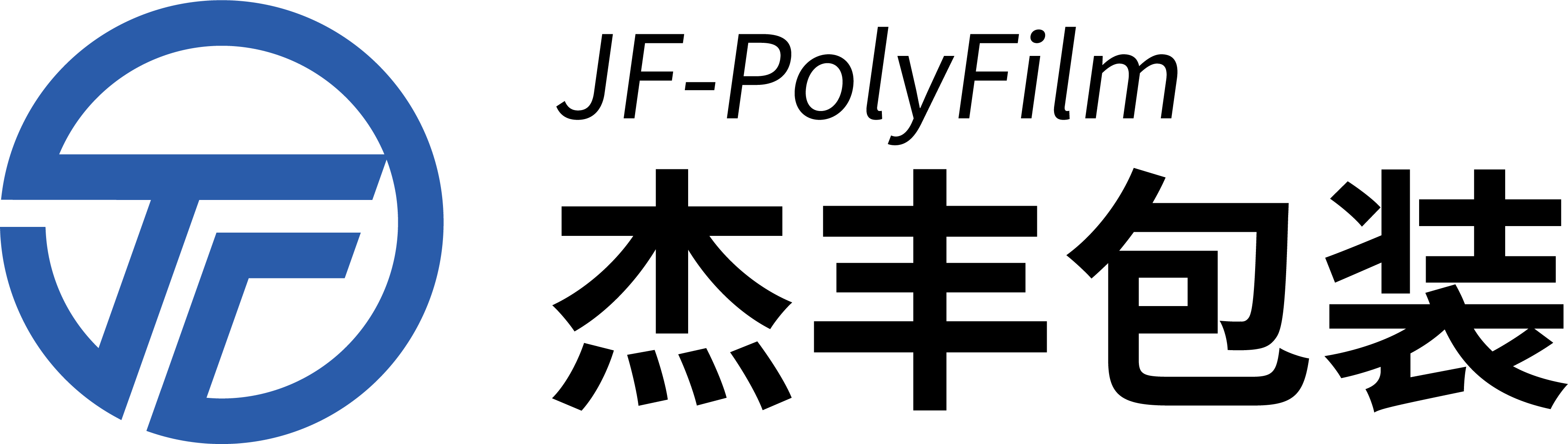
PET Shrink Sleeve Printing: Gravure vs Flexo vs Digital
How rotogravure, flexography, and digital printing differ on PET shrink sleeves — plate cost, run-length economics, variable data, reverse printing, distortion compensation, and ink-to-shrink matching.
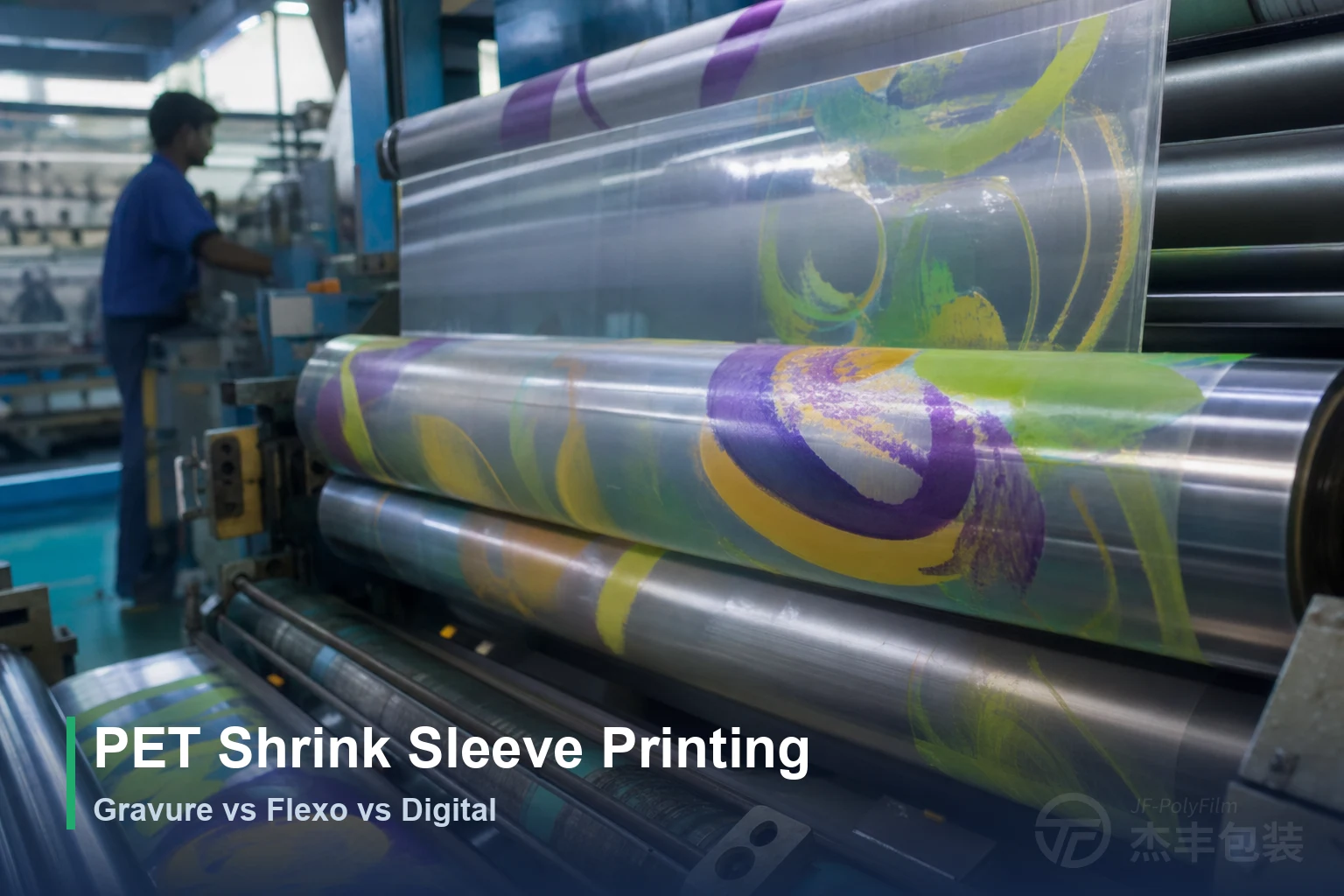
PET shrink sleeves are printed by three main methods — rotogravure, flexography, and digital — which differ in setup cost and the run lengths each pays off on. All three usually reverse-print on the film’s inner face and pre-distort the artwork so it reads true after the film draws down.
Key points
- Plate or cylinder cost is the swing factor: rotogravure engraves a separate cylinder per color, flexo images a photopolymer plate per color, and digital uses no physical carrier at all.
- Modern gravure presses run up to 400 m/min, which is why long, repeating beverage and personal-care runs settle there.
- Variable data — unique QR codes, serial numbers, regional versions — is a digital-only capability; gravure and flexo repeat one fixed image per cylinder or plate.
- Ink chemistry caps shrink: solvent and cationic UV inks tolerate films drawing 70–75%, while conventional free-radical UV and water-based inks have suited lower-shrink work.
- Surface energy of at least 38 mN/m lets the major ink families wet and bond directly, so well-conditioned PET film prints without inline corona.
The three shrink sleeve printing methods at a glance
The methods divide on one axis — how the image is stored and transferred — and that single difference cascades into setup cost, run-length economics, and how easily a job changes between SKUs. Rotogravure transfers ink from engraved cells in a metal cylinder; flexography prints from a raised photopolymer relief; digital images straight from the file with no plate.
| Property | Rotogravure | Flexography | Digital |
|---|---|---|---|
| Image carrier | Engraved metal cylinder per color | Photopolymer plate per color | None (file to film) |
| Ink lay / quality | Heaviest, densest film, smoothest gradients | Strong; HD plates close the gap | Even, fine detail; gradients depend on engine |
| Pays off at | Very large recurring orders | Short-to-medium runs | Shortest runs and one-offs |
| SKU / color change | New cylinders, longest changeover | New plates, moderate changeover | No tooling, fastest changeover |
| Variable data | No | No | Yes |
No single method wins outright. The break-even shifts with order size, number of SKUs, color count, and whether each unit must carry its own data, so all three stay in regular sleeve production.
Rotogravure: engraved cylinders for the longest runs
Rotogravure carries ink in microscopic cells engraved into a chrome-plated cylinder; a doctor blade wipes the surface clean, and the cells release ink onto the film under pressure. The cell-based transfer lays down a heavy, even ink film, which is why gravure holds dense solids and smooth vignettes across long runs without drift.
That image stability comes from tooling, and tooling is the cost. Each color needs its own engraved cylinder, so prepress is slower and the upfront outlay is high before a single sleeve prints. The economics invert at scale: once the cylinders exist, gravure runs fast — modern lines reach up to 400 m/min — and the per-unit cost falls below the other methods on very large recurring orders. Spot colors are engraved as dedicated stations rather than built from process inks, which holds a brand’s signature color steady across millions of sleeves. The same tooling weight that rewards long runs penalizes change: a revised design or an added SKU means re-engraving, so seasonal or frequently updated artwork sits awkwardly here.
Flexography: photopolymer plates and the modern HD jump
Flexography prints from a flexible photopolymer plate carrying a raised, mirror-image relief; the relief inks up and presses lightly onto the film, one plate per color. Plate-making costs less than cylinder engraving and turns around faster, which moves the break-even down into short-to-medium runs where gravure’s tooling would never amortize.
For years flexo traded that lower cost against softer detail, but HD plate imaging and servo-driven presses have narrowed the gap to the point where well-run flexo approaches gravure on most sleeve work. A SKU or color change still means new plates, so changeover sits between gravure’s re-engraving and digital’s plate-free swap. Flexo also accommodates water-based and UV ink systems readily, which gives converters a path to lower-VOC production where that is a program requirement.
Digital printing: plate-free, variable data, shortest runs
Digital printing images directly from the file with no cylinder or plate, which strips out tooling cost and prepress time entirely. A job starts cheaply and turns around quickly, so the method owns short runs, limited editions, market tests, and multi-version artwork that conventional tooling could never justify.
Its defining capability is variable data: because every impression is composed fresh, each sleeve can carry a unique QR code, a serial number for traceability, a batch identifier, or a region-specific version — all from one run. Gravure and flexo repeat one fixed image per cylinder or plate and cannot do this. The trade-off is at the top end, where per-unit cost stays above gravure and flexo once volumes climb into long repeating runs, which is the territory the cylinder methods are built for.
Reverse printing: why the graphics sit on the inside
Reverse printing lays the image on the film’s inner face — composed as a mirror so it reads correctly through a clear sleeve. After the sleeve shrinks onto the container, the printed layer is sealed between the film and the bottle rather than exposed on the outside. That position is what protects the print: the polymer film shields the ink from scuffing on the shelf, from condensation, and from ice-bath and refrigeration exposure that surface printing would leave vulnerable.
It also lifts gloss, because the viewer reads the artwork through the smooth film surface rather than across a printed top layer. White ink usually goes down last in the sequence, forming an opaque backing so the colors read cleanly against the container instead of letting its shape or contents show through. Reverse printing is a sleeve characteristic shared across all three methods, not a property of any one press.
Distortion compensation and the shrink grid
A shrink sleeve prints flat and then draws down unevenly around a shaped container, so an image printed true on the web would finish skewed on the bottle — a circle pulling into an oval where the film shrinks hardest. Prepress answers this by pre-distorting the artwork: the design is deliberately stretched in advance, exaggerated wherever the film will pull in most, so it lands correct only after the sleeve has shrunk. This step is what separates sleeve printing from ordinary label work.
The compensation map comes from a shrink grid test. A measured grid is printed on the actual film, applied to the target container, and run through the shrink tunnel; the finished grid is measured cell by cell to read exactly how much the film moved in each zone. Those anamorphic measurements drive the pre-distortion so the next print compensates correctly. Because transverse shrink dominates — the film pulls in far more around the circumference than along its length — the horizontal stretch in the artwork is the larger correction. The grid test and the pre-distortion it feeds are independent of which press prints the job; the same compensation applies whether the sleeve runs gravure, flexo, or digital.
Inks and the shrink ceiling: matching chemistry to shrink rate
The ink’s own ability to stretch sets a hard limit, separate from press choice. Four ink families serve sleeve work — solvent-based gravure inks, water-based flexo inks, UV inks (free-radical and cationic), and electron-beam inks — and they do not all reach the same shrink rate. Under heat the film pulls in fast, and an ink that cannot follow it cracks and flakes off the substrate.
The practical divide runs along ink chemistry. The solvent and cationic UV families follow the film through the highest draws — the 70–75% range needed for full-body sleeves on deeply shaped containers — without losing adhesion. Conventional free-radical UV and water-based inks have historically suited lower-shrink work, their formulations tending toward brittleness at the extreme of the curve, though newer free-radical chemistries have pushed that ceiling upward. Electron-beam inks occupy a separate niche: they cure without photoinitiators, which leaves fewer migratable species behind, so converters reach for them on sensitive packaging categories where indirect contact and odor are the concern rather than where the deepest shrink is. The takeaway for specification is direct: the film’s shrink rate and the ink system are chosen together, not in isolation.
Tension, registration, and drying: the thin-film constraints
Shrink film is thin and elastic, which makes it less forgiving on press than paper or board. Tension has to stay even across the web: a fluctuation stretches the film slightly as it runs, and a stretched web throws color-to-color registration off, blurring the fine detail and tight tolerances that sleeves demand. Web tension control is therefore a first-order concern, not a fine-tuning detail.
Inter-station drying is the other constraint, and it runs into a contradiction the film itself creates. The ink between color stations has to dry, but the same heat that dries it can begin shrinking the film prematurely if the drying temperature climbs too high — distorting the image before it ever reaches the tunnel. Set too low, and the ink stays tacky and the back of the web smears. The drying window is narrower than on heat-stable substrates and has to be held there.
These thin-film constraints are why sleeve work rewards a converter with sleeve-specific experience over a general label printer: stable web-tension control and a dialed-in drying profile are the difference between clean registration and blurred, distorted print, and they are fair things to ask a prospective supplier to demonstrate. Defects that show up after application — incomplete shrink, wrinkling, or distortion on the finished container — trace back to the tunnel and the film as often as the press, and the common PETG shrink film application problems are diagnosed separately.
How the film itself sets the printing ceiling
Press and ink are only half the equation; the film’s own properties decide what the line can hold to, and PETG ink compatibility starts with the film surface, not the press. Surface energy comes first. Gravure and flexo inks wet and bond reliably once the substrate clears roughly 38 mN/m — the lower edge of the 38–42 mN/m band these systems are formulated against — and below it the ink beads instead of laying flat. PET grades hold their surface energy far better than olefin films, so they tend not to need inline corona during the run. Films supplied here carry enough inherent surface energy to accept gravure, flexographic, and UV inkjet inks directly, which removes the corona step from prepress; the film’s surface tension is checked against the press requirement before the job starts rather than assumed.
Consistency is the next layer, because a print line tuned to one batch fails on the next if the film moves. The clear PETG film supplied here holds TD shrinkage of ≥75% with MD ≤3.0%, and every production batch is sampled — at least 5 meters drawn off and tested for shrinkage, thickness uniformity, and haze, with a Certificate of Analysis traveling with the shipment. That batch-to-batch stability is what lets a distortion map and a drying profile carry from one roll to the next instead of being re-tuned. Rolls run with zero splices in most cases, so a long gravure run is not interrupted by a join mid-web, and each roll is labeled with batch, length, and width for traceability. On the application end, a shrink tunnel held at 95–100°C draws the film down evenly so the compensated artwork finishes true.
Choosing a printing method for your sleeves
The decision routes on four questions, in roughly this order. Run length and repeat frequency come first: very large recurring orders amortize gravure’s cylinders and run fastest there, short-to-medium runs favor flexo’s cheaper plates, and short or one-off jobs belong to plate-free digital. SKU count and change frequency come next — many versions or frequent artwork updates pull toward digital and away from re-tooling. The need for variable data is decisive when present: only digital can put a unique code or version on each sleeve. And the film’s shrink rate sets the ink ceiling, which constrains the ink system regardless of press.
Two related decisions sit outside printing and are better made on their own terms. The material choice underneath the print — how a polyester sleeve compares with PVC on clarity, shrink behavior, and recycling — is laid out in the PETG vs PVC shrink film comparison. Whether a sleeve releases cleanly in the recycling wash, and which wash-off inks and floatable grades enable that, belongs to the PET shrink sleeve recyclability guide. On transparent designs the film’s own optics carry part of the brand impression, and the gloss and haze thresholds that decide it are covered in the transparent label film performance guide. For film matched to a specific shrink rate and press, JFPolyFilm supplies clear PETG shrink film printable directly on gravure, flexo, and digital lines.
Frequently Asked Questions
What is reverse printing on a shrink sleeve?
Why does shrink sleeve artwork have to be pre-distorted?
Which printing method suits the smallest sleeve runs?
Can UV inks handle high-shrink sleeves?
Does PET shrink film need corona treatment before printing?
Related Articles
How to Store Shrink Film: Rolls, Shelf Life, Handling
What the 10–30°C, 12-month storage window actually protects, how to stand rolls so they don't flat-spot, and why film has to acclimate before it reaches the line.
Shrink Film Test Methods: How Specs Are Measured
Every figure on a shrink film datasheet or COA traces back to a standard method. See which ASTM and ISO tests measure shrinkage, tensile, haze, and gauge, and how to read the report.
Need Expert Advice on Shrink Film?
Our technical team can help you choose the right film for your application.
Contact Us