
Shrink Sleeves for Bottled Water: Film Selection Guide
Speccing shrink sleeves for bottled water: thin-wall distortion on fast lines, the low-temperature shrink window, cold-chain grip, and clean bottle recycling.
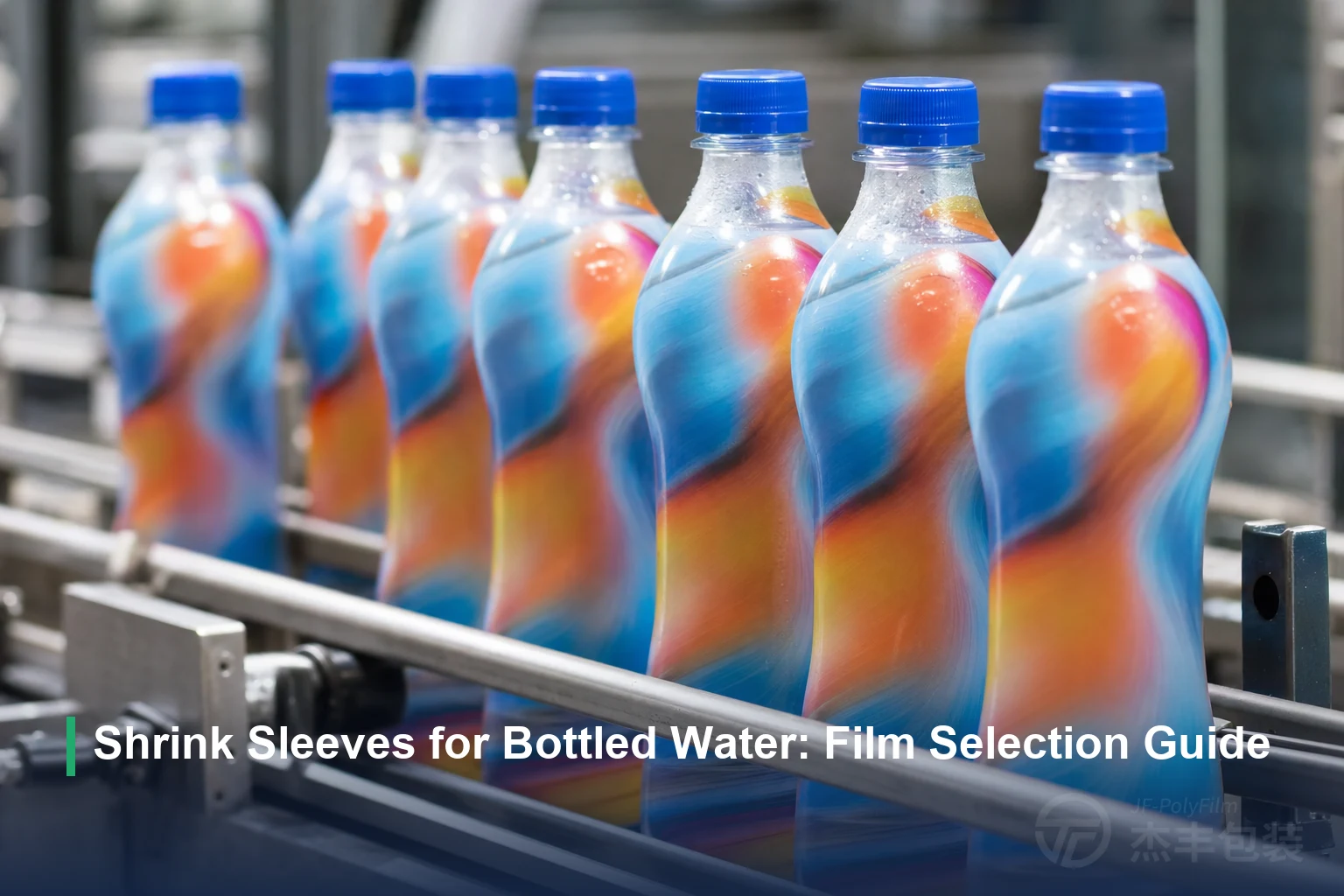
A shrink sleeve for bottled water is a printed PETG film tube slipped over a thin-walled bottle and heat-shrunk to grip it 360 degrees, serving as the decorated label and built to recover with the bottle. What decides the spec is less the graphics than three physical facts about the water bottle itself.
Key takeaways
- Water bottles are thin-walled by design — half-liter single-serve PET shed roughly 52% of its average weight between the early 2000s and the mid-2010s, to around 9.25 grams, per published beverage-industry data — so the sleeve’s real job is distortion control on a wall with almost no rigidity.
- A low, even shrink window matters more than peak temperature: PETG activates below PVC and OPS, and a crystalline CPET film widens the window further — an advantage on fast lines, where each bottle gets only a short tunnel dwell and both films shrink best around 95–100°C.
- A crystallizable CPET grade like the one supplied here melts near 230°C — inside the 225–255°C window North American recycler design guidance prefers — so it recovers with the bottle in the RIC 1 PET stream, and at 50 µm or thinner with the recommended perforation a full-body sleeve stays preferred without a sorting test.
- Recycled-content sleeves — GRS-certified RPET with a stated PCR percentage and batch traceability — close the loop the rPET bottle starts.
- The spec collapses to three priorities — show the water (clear PETG), recover with the bottle (CPET), or carry recycled content (GRS RPET) — with gauge the main per-unit lever: thinner film saves material but narrows the margin against thin-wall distortion.
What makes bottled water its own sleeving problem
Bottled water separates from the general beverage-sleeving playbook on three counts: the bottle wall is thinner, the fill line runs faster, and the pack lives in a cold chain that makes the container expand and sweat. Each pushes the specification in a direction a generic beverage recipe does not account for, so the sensible starting point is what the water bottle changes rather than what every sleeved drink shares. The mechanics a sleeve carries across all beverages — how the tube grips, the tunnel families, the anti-counterfeit and light-barrier options — are set out in the shrink sleeves for beverage bottles guide; this article narrows to the water case.
The wall comes first. Single-serve water is the most weight-optimized bottle on the market, and years of lightweighting have left the sleeve wrapping a wall so thin it flexes under light hand pressure. The film draws in mainly across its width when heated, holding its height almost constant — the what is a shrink sleeve label primer covers that format — and on a rigid bottle the draw-down is routine. On a thin water bottle it has to pull tight over a wall that pushes back very little, which is where even heat control governs the whole result.
Thin-wall distortion on a high-speed line
The core production risk on a water line is thin-wall distortion: a low-rigidity bottle and a short tunnel dwell mean any wrinkle set in the first seconds of shrink locks into the finished label, and a soft bottle can be dimpled where heat lands unevenly — so the fix is an even, controlled heat field rather than a hotter tunnel. Shrink happens in a sequence, and the film’s earliest movement decides the outcome. If one face of the sleeve reaches temperature before another, the film puckers before it has fully drawn down, and that pucker sets; no amount of downstream heat smooths it flat.
Speed sharpens the problem. A water filler running several hundred bottles a minute gives each container a short dwell in the tunnel, so the window in which the film reaches its shrink temperature is narrow and any unevenness is amplified inside it. Turning the tunnel up does not buy margin — it over-shrinks the leading face and can crush the wall — whereas an even, moist or well-baffled heat profile lets the whole tube draw down together. Steam tunnels wrap a thin, contoured bottle most evenly and reach into neck and shoulder recesses; hot-air tunnels are common and work on straighter profiles but penetrate recesses less well. The full catalogue of application faults and their tunnel-side cures is covered in solving PETG shrink film problems; the point for a water program is that the film should be chosen to tolerate an imperfect line, not to demand a perfect one.
The low-temperature shrink window
The low-temperature shrink window is the thin wall’s safety margin: a film that draws down at a low, even temperature reaches full grip before the wall overheats, and PETG begins shrinking below the temperatures PVC and OPS require, with a crystalline CPET film widening the usable window further for a fast line. Both PETG and CPET run best with a tunnel around 95–100°C, but the width of the band around that setpoint is what protects a thin bottle. A wider window absorbs the line-speed swings and dwell-time scatter that a high-speed filler produces; a narrow one turns every fluctuation into a reject.
That width is the practical reason to reach for a crystalline CPET grade on a demanding water line rather than treating it as an upgrade of clear PETG — the two answer different priorities. Clear PETG is the choice when the design shows the water through a transparent sleeve; the films supplied here run at TD ≥75% and MD ≤3.0% at 30–60 µm, which draws in tight while holding print height steady. CPET trades a little of that optical clarity for a wider processing window and bottle-stream recyclability, specified here at TD 74±2%, MD ≤5.0%, and a melting point of 230°C. The low-temperature, chlorine-free case against the older PVC default — shrink ceiling, distortion, and cost — is worked through in PETG vs PVC shrink film.
What the sleeve format buys a water bottle
Beyond decoration, the sleeve format buys a water bottle three things a pressure-sensitive label cannot: a glue-free mechanical grip that survives the cold chain, a tamper-evident seal in the same film, and 360-degree seamless graphics that lift a near-commodity pack on shelf. The cold-chain grip is most specific to water: refrigeration and freezing swell the bottle wall and draw condensation over the surface, both of which lift an adhesive label’s edge, while a sleeve has no edge and holds by film tension around the full circumference — and only tightens as the expanding wall pushes against the shrunk tube. That makes shrink tension and full-height coverage worth confirming for a chilled or frozen SKU.
The same film can carry a tamper function without a second component: a full-height sleeve or a matching neck band tears on first opening and cannot be re-formed, giving a visible first-open indicator — the sizing and material logic for that seal is in the tamper-evident shrink bands guide. And because water is close to a commodity on shelf, the seamless 360-degree canvas is where a brand differentiates, whether with a full opaque wrap or a clear “show the water” window; the print processes that put artwork on that canvas — gravure, flexo, and UV inkjet for shorter runs — are compared in PET shrink sleeve printing methods. Each of these is a reason the format, not just the film, earns its place on a water bottle.
Will the empty bottle still recycle cleanly?
A sleeved PET water bottle can be recycled cleanly, but only by design, because water is a high-volume category and the empty bottle’s fate carries weight: the sleeve either recovers with the bottle, is removed mechanically before sorting, or floats off in the wash. Which route applies is a material-and-build decision made at spec time, not an afterthought, and the three routes carry different requirements.
| Recycling route | How the sleeve behaves | What to specify |
|---|---|---|
| Recover with the bottle (RIC 1) | Crystalline CPET stays intact through wash and dry, then melts with the flake | Crystallizable CPET, melt point inside the 225–255°C recycler window, ≤50 µm, recommended perforation |
| Remove mechanically before sorting | A thin perforated film is stripped from the bottle ahead of the wash | ~50 µm or thinner, full-height vertical perforation |
| Float off in the sink-float tank | A sub-1.0 g/cm³ film rises while PET flake sinks | Polyolefin-based floatable sleeve, wash-off or alkali-resistant ink |
The recover-with-the-bottle route is the strongest for a full-body water sleeve, and it turns on chemistry. PET flake sinks in the wash at about 1.38–1.39 g/cm³, so density alone will not separate a polyester sleeve from the bottle; what matters is whether the film survives reprocessing rather than fouling it. North American recycler design guidance prefers a PET label material melting between 225 and 255°C, measured to ASTM D3418-15, because a low-melt or non-crystalline film goes tacky in the pre-extrusion dryer and clumps the flake. A crystallizable CPET grade like the one specified here, melting at 230°C, sits inside that window. In published recycler trials a crystallizable sleeve clumped under 0.6% in a hot dryer, well within the 1% limit, while a standard low-melt PETG softened and fused the flake — the mechanism examined in CPET and the RIC 1 recycling stream.
Coverage is the other half. A high-coverage sleeve normally trips a threshold — roughly above 55% of the container for smaller bottles, 75% for larger — that sends the container for a sorting test, yet the same guidance treats a crystallizable PET film at 50 µm or thinner with the recommended perforation as preferred without that test. That single provision is what lets a full-body water sleeve stay recycling-friendly instead of loading the stream. Where a sleeve must instead leave the bottle, a thin perforated film pulls off mechanically or a below-water-density film floats clear; the ink, float-sink, and perforation detail behind those routes is in the PET shrink sleeve recyclability guide. A returnable glass water bottle is a different context, where a caustic-wash-releasable label is specified for the bottle washer rather than the flake line.
Recycled-content sleeves for the rPET bottle
When the bottle already uses rPET, an ordinary virgin-plastic sleeve leaves the loop half-closed; a recycled-content shrink film carries the recycled story from the bottle onto the label, and the buyer’s real task becomes verification rather than the claim itself. Recycled PET is increasingly standard in water bottles, so a committed program has a consistency gap when its most visible component is still virgin film. Modern recycled grades run on the line like their virgin equivalents, so the switch costs nothing in shrink behaviour or print.
The load-bearing question is whether the recycled content is real and documented. A credible RPET sleeve comes with a recognized chain-of-custody certificate such as GRS, a stated post-consumer percentage rather than a bare “recycled” label, and batch-level traceability tying the delivered roll to that content; the RPET film supplied here is specified at TD ≥75% and MD ≤3.0% with a customizable PCR percentage and full traceability. How recycled-content claims are structured, certified, and audited across a supply chain is the subject of rPET packaging explained. For a water brand, the sleeve is where the recycled commitment is easiest to see and easiest to prove.
A spec brief for a bottled-water sleeve
A bottled-water sleeve spec collapses to one of three priorities — show the water, recover with the bottle, or carry recycled-content credentials — and each points to a specific film and a short set of numbers to hand the supplier. Settling the priority first keeps the brief from drifting into a generic beverage sleeve; the full substrate comparison across PETG, CPET, OPS, PVC, and PLA sits in the beverage-bottle guide, and the grade-by-grade trade-offs in clear vs white vs CPET vs RPET.
| Priority for the water program | Film to spec | Numbers to confirm with the supplier |
|---|---|---|
| Show the water through a clear sleeve | Clear PETG shrink film | TD ≥75%, MD ≤3.0%, 30–60 µm |
| Recover with the bottle, no separation | Crystalline CPET shrink film | TD 74±2%, MD ≤5.0%, melting point 230°C |
| Carry verified recycled content | RPET shrink film (GRS) | TD ≥75%, stated PCR %, full batch traceability |
Whichever row applies, the brief carries the same delivery checks: a per-batch sample of five metres or more with a certificate of analysis, roll-level traceability with a no-splice policy on the running length, and confirmation that the film prints without corona pre-treatment so a fast line loses no step. The one variable worth pinning early is gauge — thinner film saves material on a high-volume water SKU but leaves less margin against thin-wall distortion, so the down-gauge target is set against the bottle and line, not in the abstract. To move from brief to samples, send the bottle diameter and profile, the line speed, and the recycling goal, then ask for the grade that matches the chosen priority — clear PETG to show the water, CPET to recover with the bottle, or GRS RPET to carry recycled content — to trial against the actual bottle.
Frequently Asked Questions
Do shrink sleeves stay put on a water bottle through chilling and freezing?
Which film suits thin-wall bottles running on a fast line?
Is a full-body sleeve a problem for recycling the empty PET bottle?
How do you verify the recycled content of an rPET sleeve?
Steam or hot-air tunnel for a thin-wall water bottle?
Related Articles
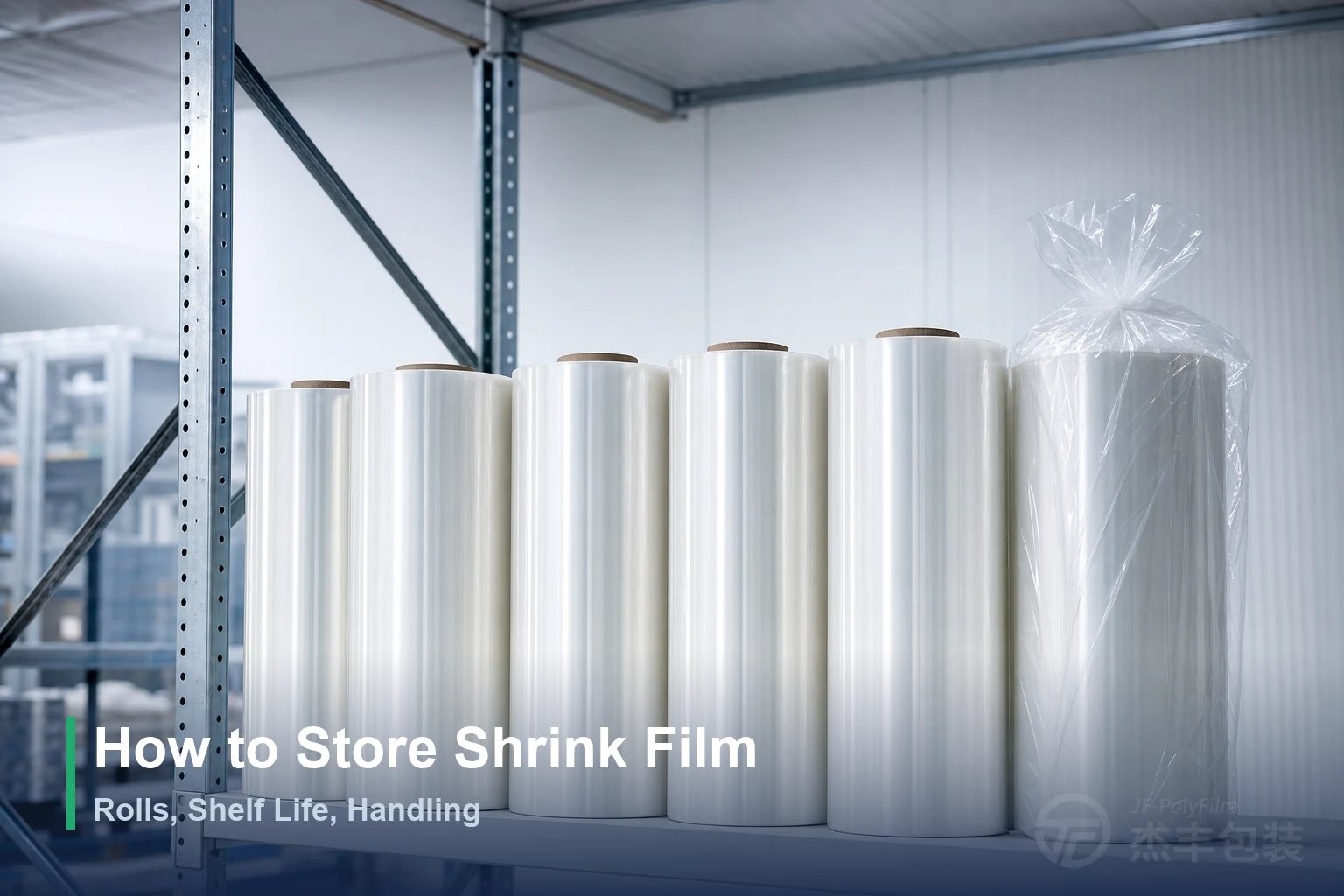
How to Store Shrink Film: Rolls, Shelf Life, Handling
What the 10–30°C, 12-month storage window actually protects, how to stand rolls so they don't flat-spot, and why film has to acclimate before it reaches the line.
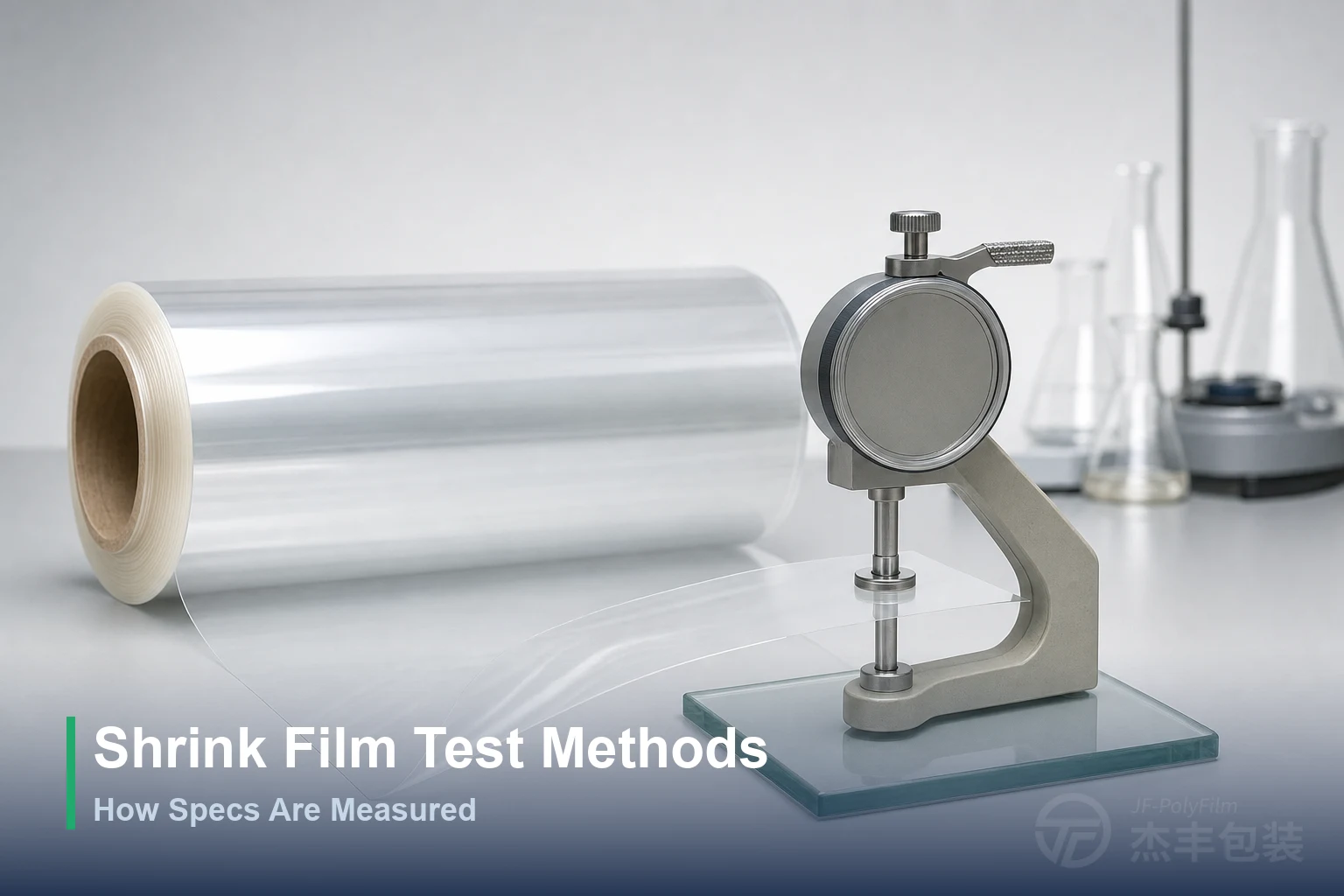
Shrink Film Test Methods: How Specs Are Measured
Every figure on a shrink film datasheet or COA traces back to a standard method. See which ASTM and ISO tests measure shrinkage, tensile, haze, and gauge, and how to read the report.
Need Expert Advice on Shrink Film?
Our technical team can help you choose the right film for your application.
Contact Us