
RPET Shrink Film: Recycled Content, GRS & Proof
How recycled content enters RPET sleeve film, what GRS verifies, and how scope and transaction certificates make a recycled claim auditable under EU rules.
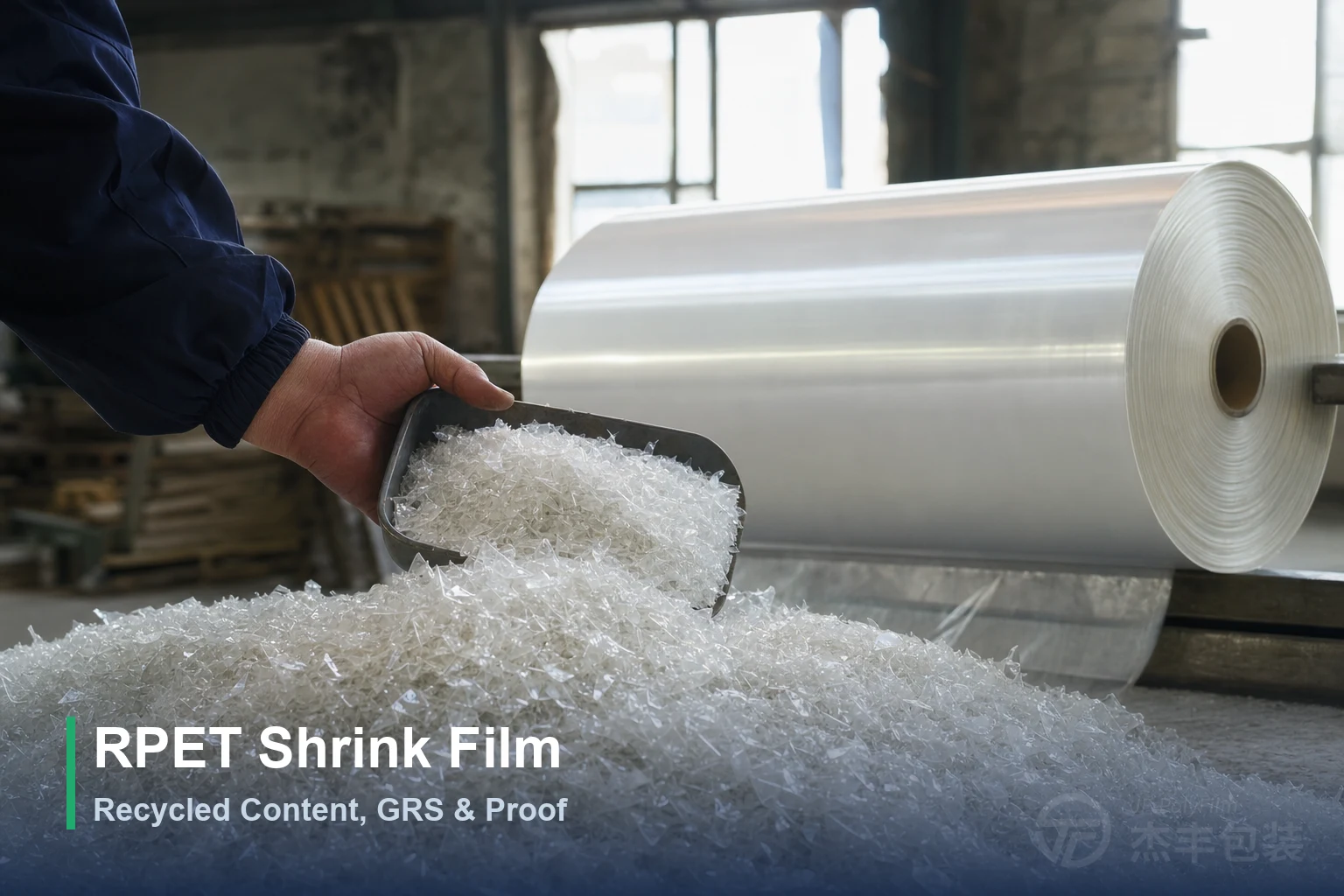
RPET shrink film — also written RPETG when the base resin is PETG — is a sleeve film whose blend swaps part of its virgin polymer for reclaimed PET, so a brand can put a verified recycled percentage on the pack while the film prints and shrinks like standard PETG.
Printing that number is easy; defending it under audit is the real work, and that is where the value of a recycled claim sits. RPET shrink film earns its place by making the claim traceable from resin to finished roll rather than merely stated. Readers new to the label format can start with what a shrink sleeve label is.
One line keeps the topic honest. Recycled content is an input claim about what the film is made from, and that is the whole of this article; recyclability is a separate end-of-life question, covered in the guide to shrink sleeve recyclability.
Key takeaways
- A recycled percentage is an accounting fact, established by certification and chain of custody rather than by testing the finished film; thermal and spectroscopic methods can flag recycled resin but never read out the figure.
- Post-consumer recycled (PCR) material is reclaimed after consumer use; factory scrap, called post-industrial, is a separate category that most regulations do not count toward recycled-content targets.
- The Global Recycled Standard (GRS) certifies from 20% recycled content and clears its consumer logo at 50%; the lighter Recycled Claim Standard (RCS) certifies from 5% and checks content and traceability only.
- Two documents make a claim auditable: a scope certificate showing the site is qualified, and a transaction certificate tying a specific shipment to the standard. A certification with no per-order transaction certificate cannot be verified.
- A weight-based EU levy on non-recycled packaging, eco-modulated EPR fees, and PPWR recycled-content minimums arriving in 2030 are why brands increasingly specify certified recycled content.
What RPET shrink film actually is
The recycled portion of an RPET film lives inside the polymer recipe, not in a coating or surface layer. Reclaimed resin is blended with virgin glycol-modified PET, then extruded and oriented on the same line that runs standard sleeve film. Because orientation, rather than the origin of the resin, sets how a sleeve shrinks and hugs a bottle, the finished film stays inside the ordinary PETG performance envelope. The recycled percentage is simply the mass fraction of reclaimed resin in the blend. That is why a “50% film” names a formulation and carries no visible marker: where the material came from has to be documented up the supply chain, because no one can see it in the label.
The real constraint sits on the supply side. Clean, certified bottle-stream rPET is in tight supply, with demand from regulation and brand pledges running ahead of what reclaimers deliver, so a target of typically 30–50%, with higher content available on request, is achievable but can weigh on lead time and minimum order. Two boundaries also keep the topic in focus: a shrink sleeve wraps the container as an outer label rather than holding the product, so questions about recycled resin in direct product contact fall outside it; and recycled content is not recyclability, which is the separate subject of the guide linked above.
PCR vs post-industrial: which recycled content counts
Recycled material divides into two families, and most rules credit only one. Post-consumer recycled (PCR) content is PET reclaimed from things people have used and thrown away — used bottles, mainly — then sorted, washed, and reprocessed into resin. Post-industrial material, sometimes called pre-consumer, is production trim and off-spec stock re-melted inside the factory before it ever reached a buyer. Both are genuinely recycled, yet regulatory targets almost always count the post-consumer fraction alone: re-melting your own scrap is ordinary housekeeping, while pulling discarded bottles back out of the consumer stream is the behaviour the rules were written to reward.
For a sleeve buyer this is worth pinning down. A recycled-content figure means little until its source is named, since 30% post-consumer and 30% post-industrial carry very different regulatory weight. A supplier who blends in factory trim and calls the output “recycled” is not being dishonest, but that material may earn nothing against a PCR obligation the brand has to meet, which is why brands under PCR mandates ask for post-consumer content specifically.
How recycled PET gets back into film
Reclaimed PET reaches the film by one of two recovery routes, and the route sets its quality before any blending. Mechanical recycling sorts, washes, shreds, and re-melts the polymer with its chemical structure intact; chemical recycling breaks PET down to its building-block monomers and re-polymerises them from scratch. Both feed the same blending step but sit at different points on the cost-and-quality curve.
| Recovery route | Molecular structure | Quality vs virgin | Energy and cost | Behaviour over repeated cycles |
|---|---|---|---|---|
| Mechanical recycling | Unchanged — the polymer is physically reprocessed | Slight drift in colour and viscosity possible | Lower energy and cost | Chains can shorten over successive cycles, nudging quality down |
| Chemical recycling | Reset to monomer, then rebuilt | Approaches virgin, sometimes restored fully | Higher energy, cost, and emissions | Each cycle returns near-virgin feedstock |
Mechanical recycling is the workhorse for bottle-stream PET and keeps the carbon and cost footprint low, at the cost of some chain scission across many loops; chemical recycling resets that clock and returns near-virgin feedstock at a higher energy and cost burden. Either way the blend is engineered to a fixed specification, so the recycled fraction never surfaces as a quality penalty in the finished label — films like ours hold the same TD shrink ≥75% and MD ≤3.0% as their virgin equivalent. For a buyer the route rarely belongs on a purchase order; what governs the claim is the certified percentage and the transaction certificate behind it.
Why a recycled percentage cannot be measured on the film
A recycled percentage cannot be read off a finished sleeve, because it describes the supply chain rather than the polymer. Once reclaimed and virgin PET are blended and oriented, the recycled chains are chemically the same molecule as the virgin ones, and nothing in the film records which atoms arrived by way of a used bottle. Verification has to travel backward through documents, not forward through a test of the roll.
Laboratory methods can hint without settling the matter: thermal analysis sometimes picks up that reclaimed resin carries a different processing history, and spectroscopy can flag contaminants typical of recovered streams, but neither returns a defensible number such as “47% recycled.” What does stand up is an auditable paper trail — certified mass in, certified product out, reconciled at every step. That reconciliation is the substance behind a recycled claim, and the certification schemes below exist to run and check the arithmetic; a number with no chain of custody behind it is a marketing line, not a verified fact.
GRS and RCS: what each certification verifies
The Global Recycled Standard (GRS) is the broad scheme, auditing four things at once across the supply chain: recycled content, chain-of-custody traceability, social conditions, and environmental plus restricted-substance practices. Despite textile origins it is not textile-only, so PETG/RPET sleeve film falls under it legitimately, and that four-part scope is what separates a GRS claim from a lone ”% recycled” line on a datasheet.
The Recycled Claim Standard (RCS) is the narrower sibling, verifying the recycled percentage and the chain of custody and nothing more. Put plainly, RCS proves how much; GRS proves how much and how responsibly. Both belong to Textile Exchange, which took the GRS over in 2011 after Control Union first developed it in 2008. Thresholds then decide which standard fits a target figure:
| Standard | What it verifies | Floor to certify | Consumer-logo threshold |
|---|---|---|---|
| RCS (Recycled Claim Standard) | Recycled content + chain of custody | 5% | — |
| GRS (Global Recycled Standard) | Content + traceability + social + environmental/chemical | 20% | 50% to use the consumer-facing GRS logo |
The practical reading is straightforward: a low recycled share can still be certified under RCS, but a brand that wants the recognised GRS mark on pack has to clear 50%, while anything from 20% to 49% can be GRS-certified without carrying that logo. Setting the target percentage and choosing the standard turn out to be one decision.
Scope vs transaction certificates: making a claim auditable
A certificate on its own does not prove a given shipment is covered; two separate documents do, and mixing them up is where many recycled claims quietly come apart. A scope certificate (SC) is issued to a facility after audit and states that the site is qualified to make certified product, listing the activities, products, and validity it covers. It establishes capability but says nothing about any particular order.
A transaction certificate (TC) is issued per shipment or batch and ties one specific delivery to the standard, reconciled against a mass-balance account so the certified volume shipped never exceeds the certified volume produced. It is the only paper that connects the claim to the goods actually received, which is why a brand buyer should require one for every order. A supplier can hold a valid scope certificate and still be unable to issue a TC for a given run, and in claim terms that run is not certified.
- Ask for the scope certificate once, to confirm the site is qualified and the certification is live.
- Require a transaction certificate with every shipment, naming your order, so the recycled volume is reconciled and traceable.
- Treat “we are certified” with no per-order TC as an unverified claim, and confirm the rest of the supplier’s credentials before committing.
Mass balance vs segregated: what the pack can honestly say
The chain-of-custody model behind a certificate decides what an on-pack statement may honestly say. Under a segregated, or physical, model, certified material is kept physically apart from non-certified material from intake to dispatch, which supports a precise product-level claim: this product contains X% recycled. Under a mass-balance model, certified and non-certified inputs are mixed and the recycled volume is allocated on paper, supporting only a portfolio-level claim: X% recycled across a product line.
The distinction governs whether a brand may print an exact figure beside the product or only an average across a range of goods. GRS runs on a physical chain of custody, which is what underpins an exact on-pack figure; a mass-balance certification can be perfectly legitimate and still fall short of licensing that precise product claim. So when a transaction certificate names a physical chain of custody and the specific consignment, an exact “X% recycled” holds up under audit; when it rests on a mass-balance allocation, the honest wording moves to the product line.
Why EU rules push brands to specify recycled content
Recycled content has moved from an ESG nicety to a cost-and-compliance lever, and most of the pressure starts in the EU, the main destination for exported packaging. The EU plastic levy has been an own resource since January 2021, charged on the non-recycled weight of plastic packaging waste; many member states pass it through to producers and importers, so lifting recycled content shrinks the taxable mass directly. Extended Producer Responsibility (EPR) fees add a second pull through eco-modulation, where packaging with higher certified recycled content pays lower fees — the exact reductions vary by member state, but the structure consistently rewards certified PCR. The Packaging and Packaging Waste Regulation (PPWR) came into force in February 2025 and generally applies from August 2026, with minimum recycled-content requirements arriving in 2030 and counting post-consumer material only; those figures differ by packaging category and read as a rising mandatory floor rather than one number for every format.
| Mechanism | In force / applies | What it means for a buyer | Buyer action |
|---|---|---|---|
| EU plastic levy | Since 2021 | Charge falls on non-recycled packaging mass; higher PCR shrinks it | Confirm the supplier can document the certified PCR the reduction requires |
| EPR eco-modulation | Live, varies by member state | Higher certified recycled content earns lower fees | Obtain the certification the relevant scheme recognises |
| PPWR | In force 2025, applies 2026, content minimums from 2030 | Mandatory post-consumer floor, rising by category | Lock in certified post-consumer content ahead of the 2030 floor |
The common thread is to lock in certified post-consumer content ahead of the 2030 floor, since the documentation a brand needs is the same whichever driver bites first. Cost is why the push comes from regulation rather than the market: recycled PET carries a persistent premium over virgin resin, and low virgin prices have kept that gap from closing, so the binding pull on specification is the mandate trajectory, not a price crossover. A lighter version of the same story runs in the United States, where several states now operate packaging EPR that rewards recycled content, though for export buyers the EU framework is the decisive one.
PETG vs RPET: choosing virgin or recycled
Everything above describes how a recycled claim is built and proven. The decision that sits on top of it is narrower — for a given SKU, virgin PETG or recycled RPET. It is easiest to make once the two things it is not about are cleared away, leaving the three that it is.
It is not a performance decision. Put a virgin grade and a recycled grade side by side and the spec sheets match: transverse shrink at TD ≥75%, machine-direction shrink held to MD ≤3.0%, across 30–60 μm thickness, with the same direct gravure, flexographic, and UV-inkjet printability. What sets those numbers is the orientation step, not where the resin came from, so a recycled blend run on the same line lands in the same envelope. The upstream work that holds reclaimed feedstock at spec — the mechanical and chemical recovery routes described earlier — is what makes that parity real, but none of it surfaces on the datasheet. Choosing recycled trades away no shrink, no clarity, and no print quality.
Nor is it a recyclability decision. Recycled content changes the input side of the film — less virgin fossil resin, and a claim the brand can carry — but not how the sleeve sorts once the pack is discarded. A PETG sleeve sits denser than water whether or not it holds recycled content, because recycled content does not move the polymer’s density, so it behaves in a sink-float separation exactly as its virgin equivalent does. If the aim is a sleeve that recovers with the bottle rather than one built from recycled input, the lever is resin chemistry, not recycled percentage — that is CPET in the RIC 1 stream, a separate material and a separate decision.
What the choice does turn on is three commercial levers:
- Cost. A recycled grade carries a premium over virgin, and that premium is not fixed. It tracks the spread between virgin and recycled resin — so it is widest exactly when virgin PET is cheap — and it climbs with both the target recycled percentage and the cleanliness the feedstock has to reach. The direction is predictable even when the number is not, which is enough to build a sensitivity view rather than treat cost as a black box.
- Supply. Certified post-consumer feedstock is the bottleneck, with demand running ahead of clean, audited supply. The higher the recycled percentage a grade targets, the more it leans on that feedstock being available, which lengthens lead time and lifts minimum order on high-content specifications. Lock certified-feedstock allocation in early for any high-content SKU rather than assume it can be topped up on short notice.
- Dual-grade cover. Because virgin PETG and RPET share one shrink and print window, both run on the same line, and that is a hedge rather than only a convenience. Route RPET to the SKUs whose recycled claim earns its keep and virgin to the rest; if a high-content grade meets a feedstock squeeze, a virgin or lower-content grade qualified on the same line absorbs the run and the line does not stop.
The rule that falls out is plain: specify RPET for the SKUs that need a verifiable recycled claim — proven by the GRS chain of custody and per-shipment transaction certificates set out above — and virgin PETG everywhere else. The two are not an either-or commitment for a catalogue; they are grades matched SKU by SKU to the claim each product has to carry.
What to look for in an RPET shrink film supplier
A sound RPET supplier turns everything above into something a buyer can verify rather than take on trust: a certified film, documents per order, and traceability that survives an audit. The recycled fraction should be set to the brand’s target, the certification should be live, and every shipment should arrive with the paperwork that ties the claim to the goods. The wider checklist is in the guide to choosing a PETG shrink film supplier; the recycled-content essentials are narrower.
JFPolyFilm’s RPET shrink film breaks down into three things a buyer can weigh separately:
- Recycled claim. GRS-certified, with recycled content set per order — typically 30–50%, with higher content available on request: 30% and 50% both clear the 20% certification floor, and 50% additionally meets the threshold for the consumer-facing label. A transaction certificate is issued per shipment, with full supply-chain traceability behind the figure.
- Performance spec. Matches virgin PETG at TD shrink ≥75% and MD ≤3.0%, across 30–60 μm thickness and 200–2000 mm width.
- Quality control. Every production batch is sampled at no less than 5 metres and shipped with a Certificate of Analysis; rolls are labelled with batch number and splice count; and the film takes gravure, flexographic, and UV inkjet ink directly, with no corona pre-treatment. Minimum order runs from 1 to 3 tonnes.
Share a target recycled percentage, your destination markets, and the bottle or line details, and we will quote with the supporting certification attached.
Frequently Asked Questions
Is RPET shrink film as clear and strong as virgin PETG?
How is the recycled percentage in a shrink film actually checked?
What is the difference between PCR and post-industrial recycled material?
Does the EU require recycled content in plastic packaging?
Why does the on-pack GRS logo need more recycled content than certification does?
Related Articles
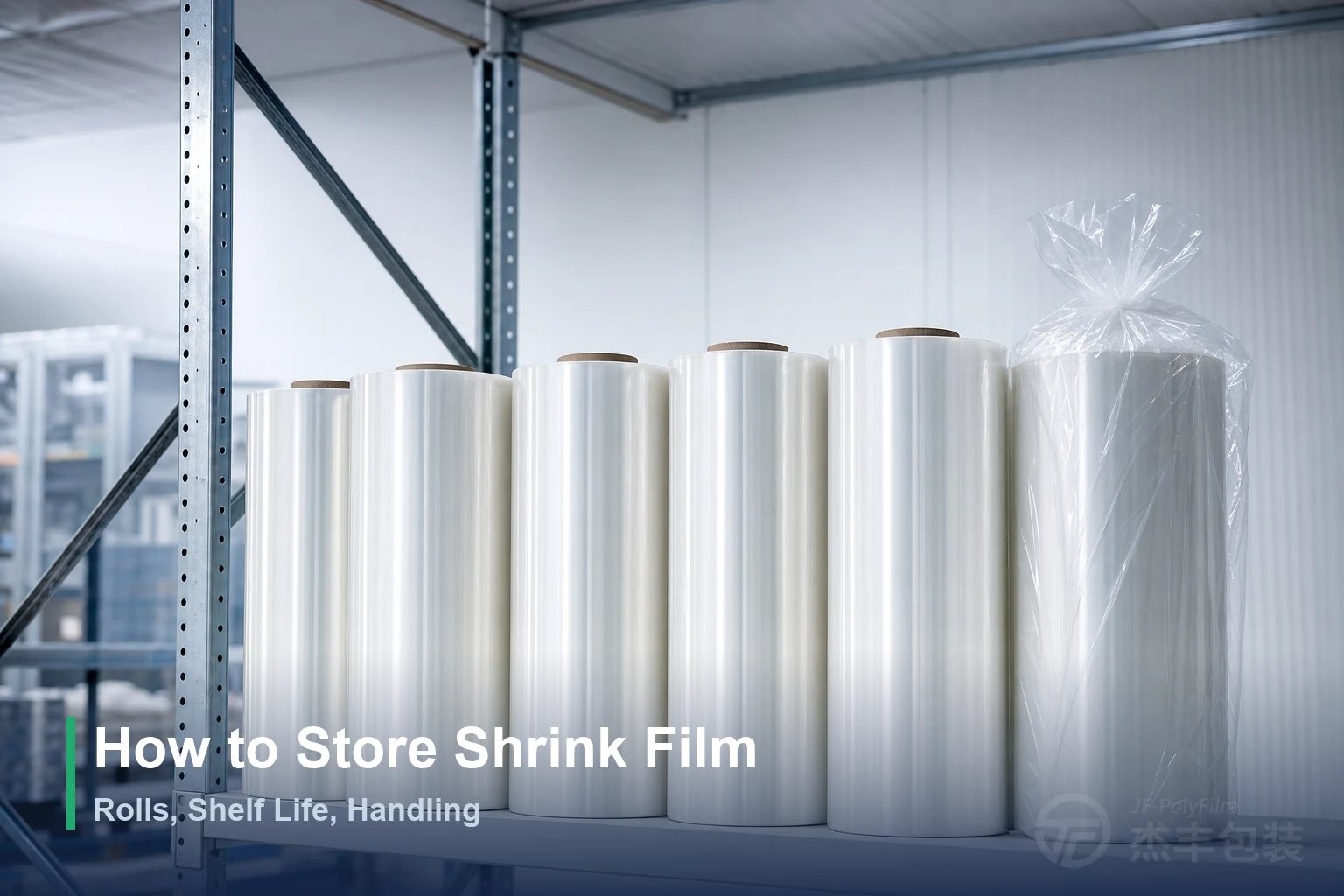
How to Store Shrink Film: Rolls, Shelf Life, Handling
What the 10–30°C, 12-month storage window actually protects, how to stand rolls so they don't flat-spot, and why film has to acclimate before it reaches the line.
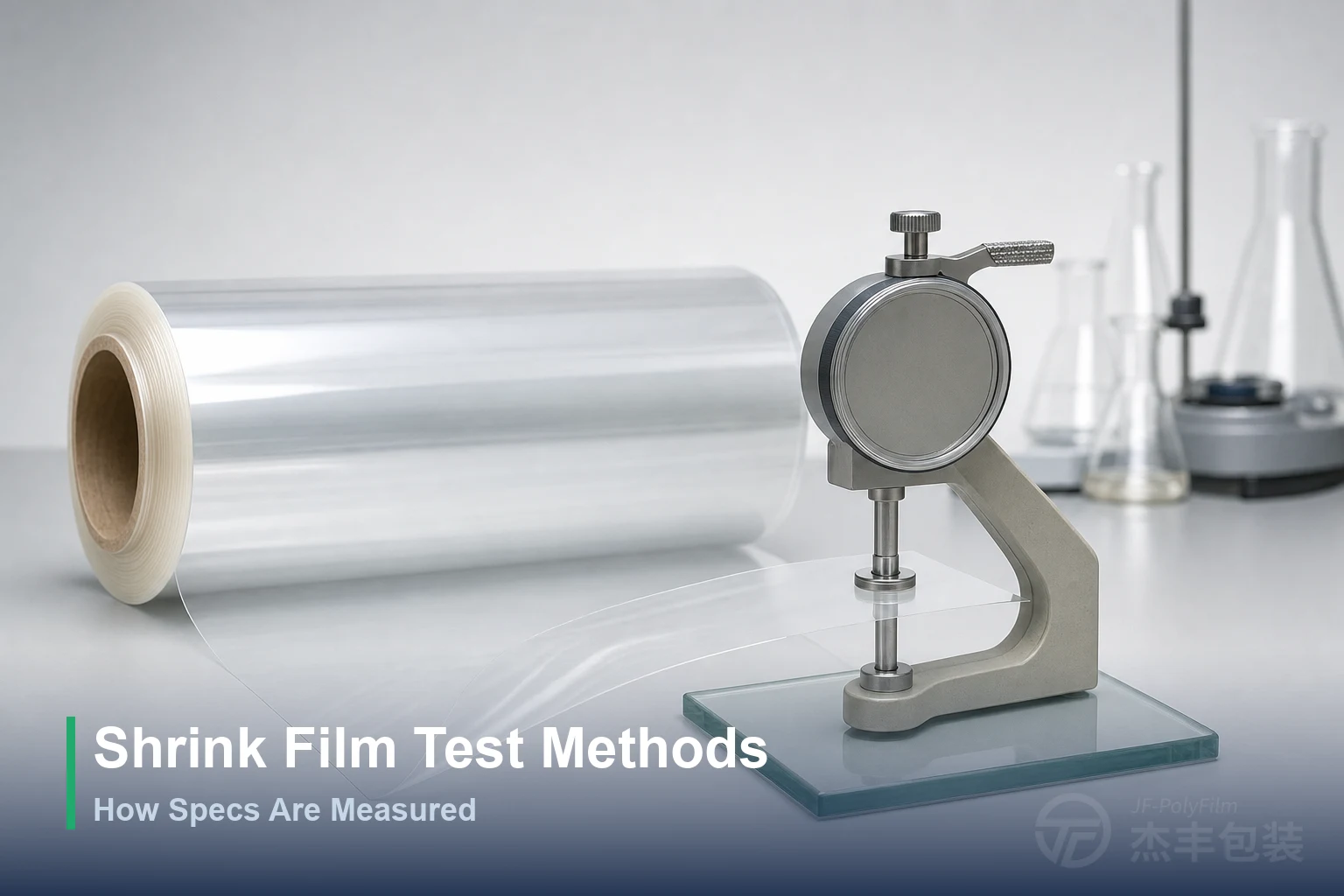
Shrink Film Test Methods: How Specs Are Measured
Every figure on a shrink film datasheet or COA traces back to a standard method. See which ASTM and ISO tests measure shrinkage, tensile, haze, and gauge, and how to read the report.
Need Expert Advice on Shrink Film?
Our technical team can help you choose the right film for your application.
Contact Us