
Clear vs White PETG Shrink Film: Which to Choose
Choosing clear vs white PETG shrink film comes down to two questions: does the pack need to show the product, and does the fill need protection from light? A practical selection guide.
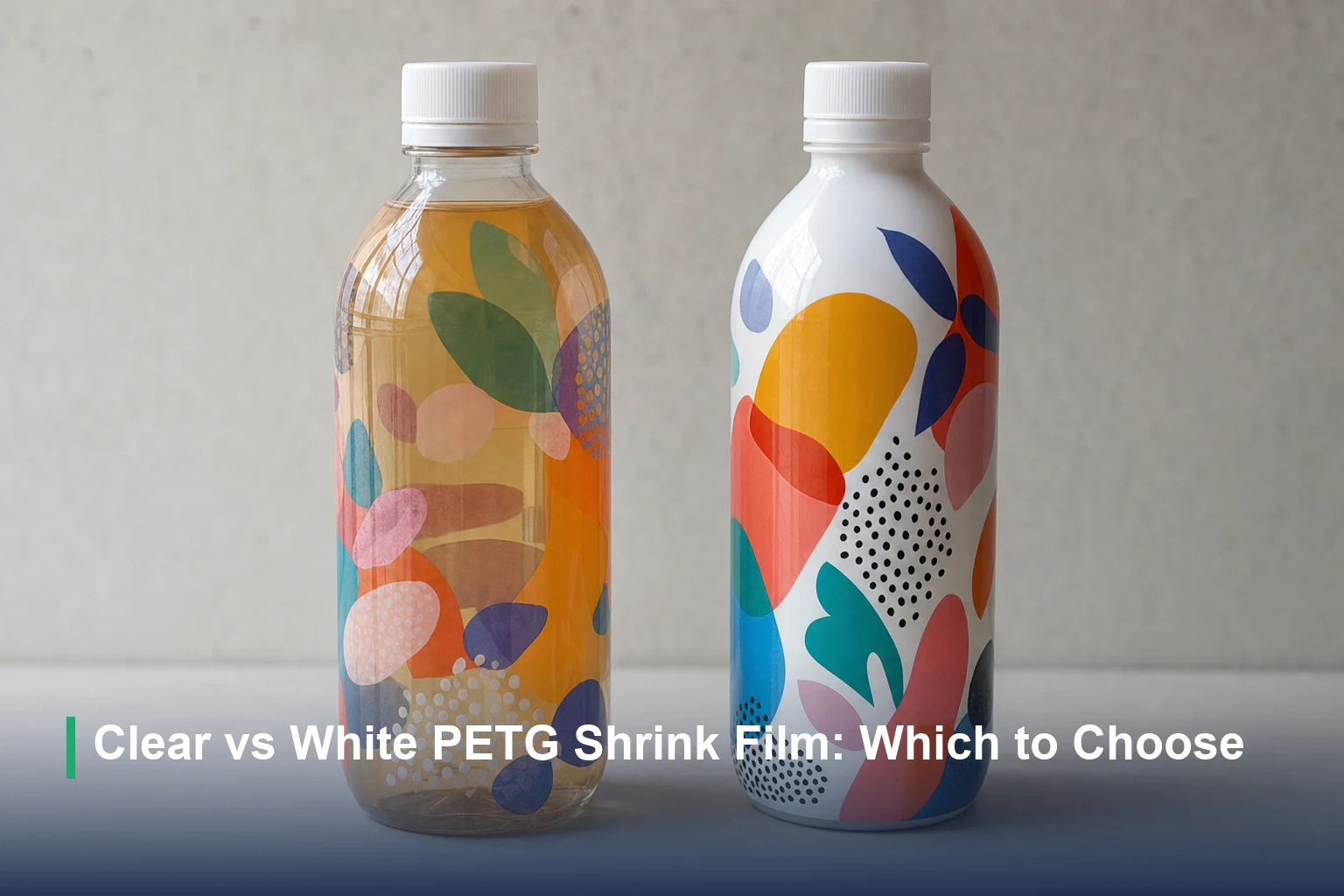
Clear and white are the two PETG shrink films a buyer weighs first, and the split between them is simple to state: clear film is fully see-through and lets the product itself do the selling, while white film is opaque, blocking light and giving artwork a solid background to print against. Both ride the same PETG base and shrink by the same mechanism, so choosing between them is a question of what the pack needs to show or hide, not a contest between a stronger and a weaker film.
Key takeaways
- Clear PETG puts the contents on display; white PETG hides the fill, blocks light, and gives graphics a solid opaque background.
- Both grades shrink the same way: transverse (TD) shrink in the high 70–80% band, machine-direction (MD) shrink held low at 3.0% or below. The choice is about optics, not performance.
- White PETG cuts light transmittance to roughly 30% or below, shielding light-sensitive fills such as dairy, supplements, and photosensitive cosmetics; clear PETG offers no light protection.
- Clear film needs a white ink layer printed behind the colours to keep artwork opaque; white film prints directly on its own opaque base.
- Decide with three questions: should the contents be visible, does the fill need light protection, and does the design need a solid background colour.
Clear vs white PETG: the two-line difference
Clear PETG is the default when the product sells on what is inside. Transparent film leaves it all on view: the colour of a juice, the clarity of a spirit, the line of a contoured beverage bottle. A clear sleeve reads almost as no label at all, a printed graphic floating over an unobstructed view of the container. JFPolyFilm’s clear grade holds high transparency from the first metre to the last while running transverse shrinkage of 75% or above, so it draws down onto shaped and tapered bottles instead of standing off a curved surface the way a stiff, low-shrink label would.
White PETG does the opposite job. It is opaque, so it conceals the fill, wraps the container in a solid colour, and keeps light off the contents — the part that matters most for certain products. Where clear film shows everything, JFPolyFilm’s white grade hides everything and hands the designer a clean, uniform background across the full body of the pack. Neither is the better film in the abstract. One is chosen to reveal, the other to conceal, and the product decides which.
Optics: transparency versus opacity
The optical difference is where clear and white part company, and it is worth reading past the single number a spec sheet quotes. Clear PETG is measured on clarity, gloss, and haze — haze being the fraction of light scattered as it passes through, which is what makes a film look milky rather than glass-clear. A good clear shrink grade keeps haze low so the container stays crisp underneath. White PETG is measured the other way, on how little light it lets through: JFPolyFilm’s white grade runs light transmittance of roughly 30% or below, opaque enough to conceal the fill and shut light out around the whole body of the bottle.
One thing to watch is that a flat-sheet reading is not the finished look. Haze and transmittance are measured on film lying flat, but a sleeve is judged after it has shrunk tight onto a curved bottle, where the film thins slightly as it draws down and the curvature bends the light. A clear film can look marginally hazier on a deep-shouldered bottle than its flat number suggests, and a white film’s coverage tightens as it conforms. The practical read: treat the flat spec as a starting point and confirm the on-bottle appearance with a shrink trial, because the shelf sees the shrunk sleeve, not the sample sheet.
Opacity itself comes in degrees. A standard white grade blocks the bulk of incoming light, enough to hide the fill and give the artwork a solid ground, while a full 99–100% blackout is reserved for films that also carry a black backprint layer behind the white. For most products the standard opaque white covers both needs: it conceals the contents and blocks the light that would harm them.
Where each one fits: matching the grade to the product
Clear PETG belongs on products that look better seen than hidden. Transparent and pale-tinted beverages, spirits, oils, clear-gel cosmetics, and any bottle whose shape or colour is part of the pitch all gain from a sleeve that disappears against the container. The sleeve carries the branding and the mandatory copy without cutting off the view a shopper wants. It is a see-through pack that still tells its story.
White PETG earns its place for three distinct reasons, and it is worth separating them. The first is light protection. Some fills degrade under light: cultured dairy and dairy drinks lose vitamins and pick up off-flavours, supplements and vitamins oxidise, and light-sensitive cosmetic and personal-care formulas discolour. For these, an opaque sleeve does two jobs at once: it carries the graphic and blocks the light. Only white delivers the second. Matching an opaque grade to a light-sensitive fill is the call a dairy programme faces, walked through in shrink sleeves for yogurt cups and dairy.
The second reason is a design one: a solid, even background. A brand that wants deep, saturated colour or a clean pale ground for its artwork gets it directly from white film, where a clear film would need an added opaque ink layer to hold the same effect. The third is concealment for its own sake: a translucent bottle with an uneven fill level, or contents whose real colour is unappealing, reads better under an opaque wrap than a transparent one. In each case the product is telling the pack to hide rather than reveal, and white is the grade that listens.
Printing: why the film choice changes the artwork
The film a design prints on changes how the artwork has to be built, and this is often the deciding practical difference between the two. White PETG carries its own opaque background, so inks lay down over a solid ground and colours hold their true density — what the designer specifies is what appears on the shelf.
Clear PETG has no such base. Print colour directly onto a transparent film and the container, the liquid, and the light behind it all show through, washing the graphic out and shifting its colour. The fix is a white ink layer printed behind the colours, usually as part of a reverse-printed construction where the artwork is printed on the inside face of the film and backed with white so the colours read correctly from the front and the ink is protected by the film itself. That white underprint is what lets a clear sleeve carry a bold, opaque graphic while keeping the unprinted windows genuinely see-through. It is a routine step, not an obstacle, but it is an extra one. A design that runs directly on white PETG needs an added ink pass to hit the same result on clear. Both grades accept gravure, flexographic, or UV inkjet printing without corona pre-treatment, so the press process itself does not change when the grade does — only the colour build behind it.
Specs: what the two grades share and where they split
Because clear and white start from the same PETG resin, most of their numbers line up. Both draw down in the high transverse band that a full-body sleeve needs: TD sits in the 70–80% range, with JFPolyFilm’s clear grade rated at 75% or above, while machine-direction shrink stays low, at 3.0% or below, so the sleeve tightens sideways around the container without shortening vertically and dragging the artwork out of registration. Both run in the same 30–60 μm thickness range, come in widths to 2000 mm, and shrink cleanly in a tunnel held between roughly 95 and 100°C, whether hot-air or steam. Storage, shelf life, and minimum order are identical too, since it is one material family underneath: a minimum order around one tonne, storage at 10–30°C, and a 12-month shelf life in original packaging.
Where they split is how white gets its opacity, and there are two routes to it. In a cavitated grade, the film is filled with microscopic voids that scatter incoming light — an effect called micro-voiding — so the sheet reads opaque without a heavy pigment load. In a solid grade, a white pigment such as titanium dioxide does the blocking, absorbing and reflecting the light that would otherwise pass through. Either construction reaches the high transverse shrink a full-body sleeve needs and holds machine-direction shrink at 3.0% or below, so white draws down onto curved and tapered bottles as readily as clear, right into deep shoulders and sharp tapers. The construction is a manufacturing choice, not a performance trade: white conceals and shields the fill, clear reveals it, and the product decides which job matters.
Density is one place the two white constructions part ways, and it is a recycling matter rather than a selection one. Clear PETG sits near 1.28–1.33 g/cm³ — around 1.32 in a typical grade — the density of the base resin. A cavitated white runs lighter: the internal voids lower its specific gravity, and a fully voided grade can fall below 1.0 g/cm³, light enough to float in a water bath while the heavier PET flakes from the bottle sink, so the sleeve separates cleanly in a float-sink recycling stream. A solid pigmented white goes the other way, since titanium dioxide is dense — roughly 4.2 g/cm³ — and lifts the film’s specific gravity above the clear grade’s. Whether a white sleeve sinks with its bottle or floats free of it is an end-of-life sorting question, not one that bears on the clear-versus-white decision, which turns on optics and print rather than on weight.
Choosing between clear and white: three questions
Laid against a real product, the decision resolves into three questions asked in order.
- Should the contents be visible? If the product sells on what is inside (colour, clarity, the shape of the bottle), clear PETG keeps it on show. If the fill is better hidden, white PETG covers it.
- Does the fill need light protection? If the contents degrade under light (dairy, supplements, photosensitive formulas), white is the only one of the two that blocks it. Clear offers no shield.
- Does the design need a solid background? If the artwork calls for deep, even colour or a clean opaque ground, white supplies it directly; clear can approximate it only with an added white ink layer.
If either of the last two questions is a yes, choose white. If all three are a no on a product worth showing, choose clear. The table below sets the two side by side on the axes that decide it.
| Clear PETG | White PETG | |
|---|---|---|
| Contents visibility | Fully see-through; product on display | Opaque; fill concealed |
| Light protection | None — light passes through | Blocks light; transmittance ≤30% |
| Printing | Needs white ink underprint for opaque colour | Prints directly on its own opaque base |
| Typical uses | Clear/tinted beverages, spirits, oils, clear-gel cosmetics | Dairy and light-sensitive drinks, supplements, photosensitive cosmetics; solid-colour designs |
| TD / MD shrink | TD ≥75%, MD ≤3.0% | High-shrink band, MD ≤3.0% |
Numeric specs are JFPolyFilm’s published grade figures; the optics and printing columns describe general grade behaviour. Confirm the on-bottle result with a shrink trial on the target container before committing volume.
If the choice is instead being driven by whether the sleeve can recycle with the PET bottle or carry a verifiable recycled-content figure, that is a different axis altogether, covered in CPET and RIC 1 recycling explained and RPET packaging explained — not the visibility-and-light question that separates clear from white.
Confirming the choice before volume
A grade that fits on paper still has to fit on the line, so the decision ends with a shrink trial rather than an assumption. Requesting short rolls or A4 sample sheets and running them at the target tunnel temperature on the actual container is the only proof that a clear film stays crisp on a deep shoulder, or that a white film covers evenly and reads at the colour density the artwork intends. The shrink-rate choice tracks the bottle’s curvature the same way for both grades, so a straight-walled water bottle and a deeply contoured cosmetic bottle may take the same colour of film at different shrink rates. Share the target container, the required shrink rate, and whether the fill is light-sensitive, and the answers point to the right grade: clear to reveal, white to conceal and protect.
Frequently Asked Questions
Should I choose clear or white PETG shrink film?
Does white PETG shrink film block light?
Can you print full-colour graphics on clear PETG shrink film?
Is there a shrink or clarity trade-off with white PETG?
Can a clear bottle still use a white shrink sleeve?
Related Articles
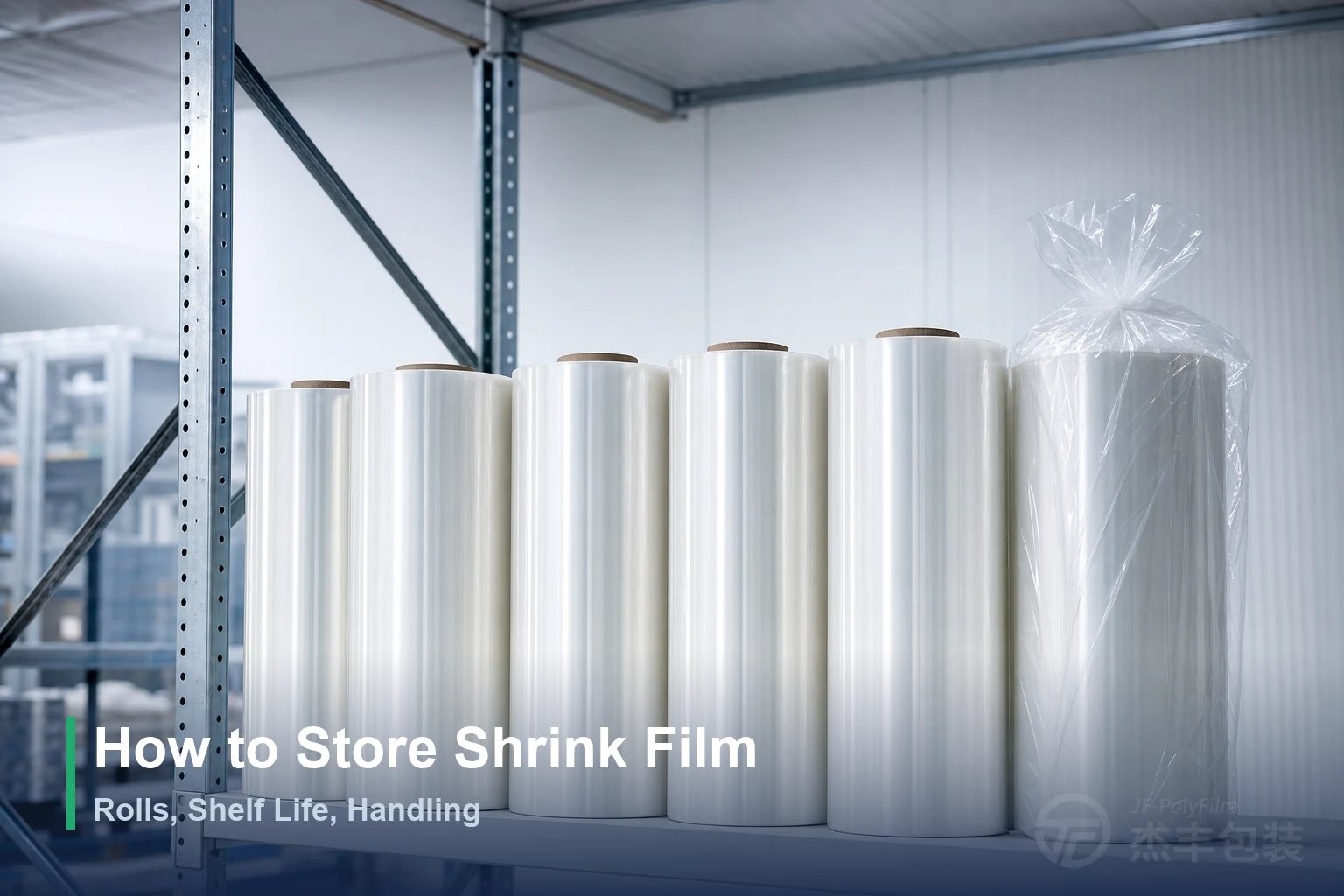
How to Store Shrink Film: Rolls, Shelf Life, Handling
What the 10–30°C, 12-month storage window actually protects, how to stand rolls so they don't flat-spot, and why film has to acclimate before it reaches the line.
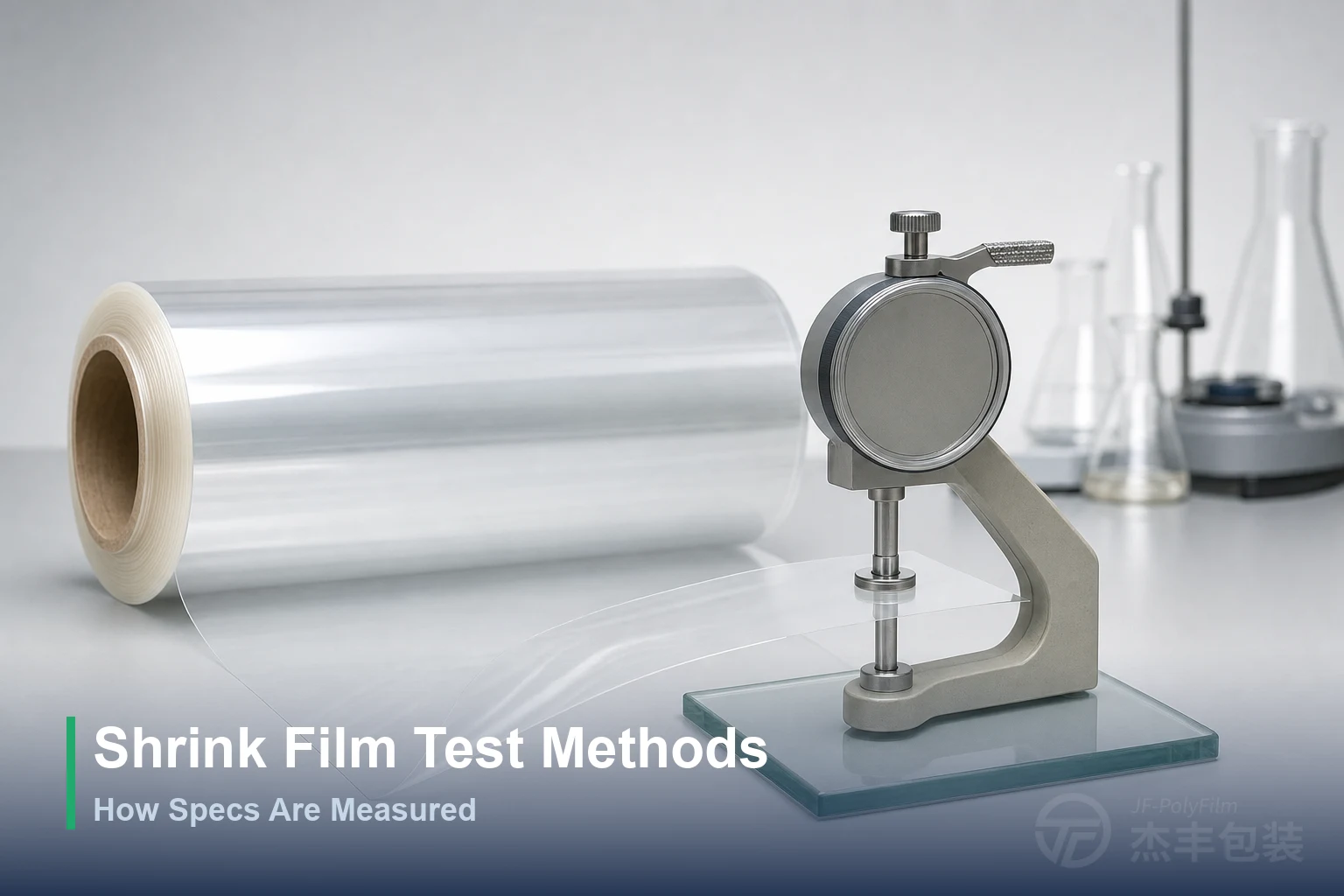
Shrink Film Test Methods: How Specs Are Measured
Every figure on a shrink film datasheet or COA traces back to a standard method. See which ASTM and ISO tests measure shrinkage, tensile, haze, and gauge, and how to read the report.
Need Expert Advice on Shrink Film?
Our technical team can help you choose the right film for your application.
Contact Us