
PETG vs POF Shrink Film: Which Fits the Job?
PETG vs POF shrink film compared by job — directional vs biaxial shrink, recycling streams, gauges and crosslinking — so the right film matches the package.
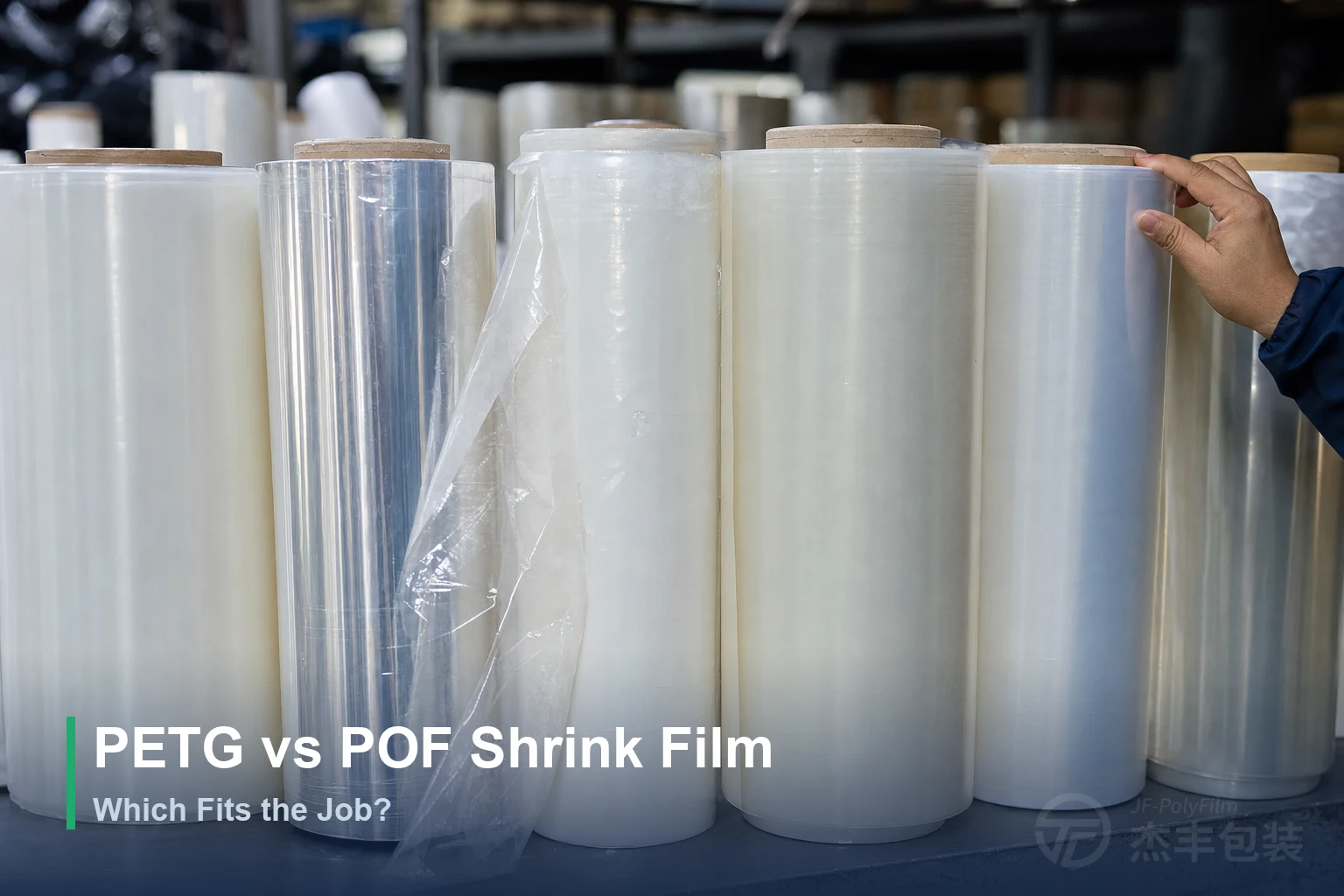
A search for “PETG vs POF shrink film” usually pits two films that were never built to compete. PETG is a high-shrink polyester used to print full-body sleeve labels that wrap one bottle 360°; POF (polyolefin) is a clear polyethylene-family film used to overwrap or bundle products together. The two solve different problems, so the right pick follows from the job being bought for.
- A sleeve film and a bundling film are not graded on the same scale: one carries print, the other carries load.
- PETG sleeve grade shrinks hard across the bottle — high in the transverse direction — while staying almost still lengthwise, which keeps artwork undistorted.
- POF shrinks by similar amounts in both directions — independent industry sources cite roughly 45–70% — so it closes evenly over a box or bundle.
- PET and CPET sink in water (about 1.28–1.38 g/cm³) and sort into the RIC 1 PET stream; polyolefins float (below 1.0 g/cm³) into a separate stream.
- Sleeve film is ordered in microns (30–60 μm); overwrap and bundling film is ordered in gauge (roughly 45–100).
The core split: a label film versus a load film
PETG and POF are best understood as answers to two different questions rather than two grades of one product. One question is how do we put high-resolution graphics on a contoured container? The other is how do we hold a pack of items together, or give a box a clean retail finish? A label film carries print around a single body; a load film encloses one or more items. Almost every “PETG vs POF” decision collapses once the job is named.
That framing matters because the two films share enough surface traits to invite a head-to-head that the application does not support. Both are heat-shrink films, both pass through a shrink tunnel, and both arrive on rolls. Yet they sit at opposite ends of the shrink-packaging map: PETG (glycol-modified PET) belongs to the printed-sleeve family alongside its PET-family relative CPET, with PVC, OPS, and PLA also serving that market, while POF belongs to the overwrap-and-bundling family alongside PE for the heaviest loads. The sleeve side has its own internal contest, set out in the PETG vs PVC shrink film comparison. Treating the two families as substitutes is the root of most confusion, so the rest of this guide routes by job, not by a single “winner.”
Directional shrink is the real dividing line
The factor that actually separates these films is not how much they shrink but in which direction. A sleeve film and an overwrap film are engineered for opposite shrink geometries, and that single design choice predicts almost everything downstream — fit, print stability, and the kind of package each can close cleanly. Headline shrink percentages mislead here, because two films can shrink by similar totals and still behave nothing alike.
PETG sleeve film is built for directional shrink: high in the transverse direction (TD, around the body) and very low in the machine direction (MD, along the length). It pulls tight around a tapered or contoured bottle while the artwork barely moves lengthwise, so text and barcodes stay legible and undistorted. POF is built for near-balanced biaxial shrink: it contracts by comparable amounts on both axes — even enough in each direction to close over every side of a box or bundle without twisting. That four-sided pull is precisely what a 360° sleeve must avoid, which is why POF is never used as a full-body sleeve — and why PETG’s near-zero lengthwise shrink would pucker a flat overwrap.
The shrink temperature windows reinforce the split. Across PETG sleeve grades the best sleeve results land in the 95–100°C range, with practical options spanning a boiling-water bath, a steam tunnel, and a hot-air tunnel that runs a 95–110°C surface temperature while the film itself reaches about 95°C. POF runs its own tunnel profile tuned to close a wrap evenly rather than to mirror a contour, and its real temperature edge is at the cold end — it stays flexible in chilled and frozen service instead of turning brittle. The two profiles are not interchangeable: a tunnel tuned for even overwrap shrink will not develop the high TD pull a sleeve needs, and a sleeve tunnel would scorch a thin overwrap. The temperature target follows from the shrink geometry, not the other way around.
Why the direction matters so much comes down to how a sleeve and a wrap fail. A sleeve that shrinks even slightly along its length drags barcodes and text out of register, distorting the print the brand paid for; the whole point of low MD shrink is to lock that dimension. A wrap that shrinks unevenly leaves slack on one face and over-tightens another, puckering the film and loosening the pack. Each film is engineered against the failure mode that matters for its own job. Neither shrinks “more” in any meaningful sense; they are built for different geometries.
PETG shrink films: built to carry print
When the film itself becomes the printed face of the product, PETG is the purpose-built choice. Its defining property is that high TD shrink paired with very low MD shrink, which is the controlling spec for sleeve labels: the film grips the bottle body while the graphics hold their proportions lengthwise. That combination is what makes a seamless full-body sleeve, a tamper-evident neck band, or a deeply contoured shaped-bottle wrap possible at all.
The verified envelope across our PETG sleeve grades sets the reference point. Shrink runs TD ≥75% with MD ≤3.0%; thickness spans 30–60 μm; widths reach 200–2000 mm; and the film accepts gravure, flexographic, and UV-inkjet ink directly, without a separate corona pre-treatment step. High TD shrink is exactly what a deep curve demands, because the film has to travel a long way around the widest point of a contoured container and still seat flat against the narrow neck.
The geometry sets the lower bound on shrink. A cylindrical can asks little of the film, but a waisted bottle, a tapered cosmetic container, or a handled jug forces the sleeve to contract by a large fraction of its layflat width to follow the surface without bridging across the hollows. A grade that tops out at moderate shrink leaves gaps at the deepest curves; a high-TD grade closes them. That is the practical reason sleeve films are pushed to the top of the shrink range while overwrap films are not — the sleeve has to mirror a three-dimensional contour, while a wrap only has to close around a box. Thickness is then chosen against the same job: thinner grades within the 30–60 μm band reduce material per sleeve and shrink quickly, while heavier grades add stiffness for tall or large-diameter sleeves that would otherwise buckle during application.
The PETG family also branches into grades tuned for specific jobs, each a short detour from the clear sleeve baseline. A white, light-blocking grade adds opacity for light-sensitive products while keeping sleeve shrink behavior. Recycled-content grades carry post-consumer PET for recycled PETG sleeves, with the broader recycled-content picture in RPET packaging explained. And CPET, a crystalline PET-family grade, is engineered to recover together with the bottle — covered in depth under CPET and the RIC 1 stream. Each variant trades on the same directional-shrink foundation rather than abandoning it.
POF shrink films: built to carry load
POF is the better tool whenever the film’s job is to enclose rather than to print. It is a polyolefin, typically built as a multilayer coextrusion — a polypropylene-type outer skin over a softer polyethylene-family core — which gives it clarity and gloss for retail shelves combined with the toughness to hold a pack. Where PETG carries graphics, POF carries the product. A heavier, tougher relative in the same polyolefin family — PE bundling film — carries real weight instead: cases, beverage multipacks, and pallet loads, though without POF’s optical clarity, which makes it a load-securing film rather than a shelf-facing one.
Several traits make POF well suited to that role. Its near-balanced biaxial shrink, cited by independent industry sources in a roughly 45–70% range, closes evenly over boxes and bundles. It stays flexible at low temperatures rather than turning brittle, which suits chilled and frozen goods. And it can be drawn very thin — independent industry grades reach down toward 12 μm, the lighter end of the common 45–100 gauge band (≈11–25 μm) — when the job needs only a clean enclosure rather than a thick protective skin. None of these traits depends on print, because detailed full-body graphics are not what the film exists to deliver.
The jobs that follow from this are exactly the ones a sleeve film cannot do. Clear single-item overwrap on a boxed product gives a tamper-clear retail finish. Light multipacks bind several units into one sellable pack. Frozen-food enclosure and other chilled applications exploit the cold flexibility. Each of these is everyday work for POF and impossible for a directional sleeve film — a reminder that “which is better” has no answer until the package is specified.
Crosslinked vs standard POF: a difference most comparisons skip
Polyolefin film comes in two structurally different forms, and most side-by-side comparisons never separate them. Standard POF is oriented by stretching and cooling the polymer melt, then relaxed by tunnel heat. Crosslinked POF is treated, typically by electron-beam or other irradiation, so the polymer chains bond into a three-dimensional network instead of staying linear. That structural difference, not a change of resin, is what sets the two apart.
Standard (non-crosslinked) POF is the more economical, easier-to-run option. Its melt orientation makes it forgiving on high-volume lines, it tends to begin shrinking at lower temperatures, and it is the sensible default for lightweight, low-risk overwrap where no special toughness is needed. For a large share of retail wrapping, it is all the film a pack requires.
Crosslinked POF earns its higher cost where standard film struggles. Independent sources credit the irradiated network with a wider heat-sealing and shrink window, higher tear and puncture resistance, and enough added strength to allow downgauging — a thinner film doing the same work. The wider sealing window is the operational headline: it gives fast automatic wrappers more seal latitude, so a line runs without constant temperature retuning, and the extra puncture resistance lets the film wrap heavier or sharp-edged products that would split a thinner untreated film. Crosslinking improves durability and processing latitude; it does not turn POF into a directional sleeve material.
Density and the recycling stream: why the resin choice routes the package
Choosing the resin also chooses the recycling path, because density decides how a film sorts at end of life. PET and CPET are denser than water at roughly 1.28–1.38 g/cm³ and sink; polyolefins fall below 1.0 g/cm³ and float. In density-based separation — a sink-float step common in plastics recovery — that difference physically splits the two families into different streams before any other sorting happens.
The consequence is concrete for package design. A PET-family sleeve can be engineered to stay with a PET bottle: CPET in particular shares essentially the same chemistry as the bottle, carries a melting point of 230°C that survives standard PET recovery, and recovers in the RIC 1 PET stream with no separate label-removal step. A polyolefin film, by contrast, floats off into its own stream and would contaminate a PET load if mixed in. For mono-material PET packaging the choice is therefore not cosmetic — it is what keeps the bottle stream clean.
This cuts both ways, and reading it as “PET good, polyolefin bad” misses the point. A polyolefin film is the right recycling answer when the surrounding package is itself polyolefin: a POF overwrap on a polyethylene-based pack keeps that material consistent rather than introducing a denser contaminant. The principle is the same in either direction — the film should match the dominant material of the package it serves, so the whole unit sorts cleanly into one stream. A sleeve added to a PET bottle should read as PET; a wrap added to a polyolefin pack should read as polyolefin. Density is simply the physical mechanism that enforces that logic on the sortation line, ahead of any optical or marker-based sorting that follows. The full label-recovery picture, beyond this density mechanism, is set out in PET shrink sleeve recyclability.
Choosing the right film: matching the film to the job
The decision comes down to one routing question asked before any spec sheet: is the film carrying the brand, or carrying the load? Brand goes on a sleeve-label film; load goes on polyolefin. Get that first fork right and the family is largely settled, with the rest of the specification — shrink axis, sizing language, recycling target — following from it rather than driving the choice.
A second fork opens once “load” is chosen, because polyolefin is not one answer but three. Standard POF handles light, clear, shelf-facing overwrap and small multipacks. Crosslinked POF takes the faster automatic lines and the heavier or sharp-edged packs that need a wider seal window and more puncture resistance. PE takes the real weight — cases, beverage multipacks, and pallet loads — where bundle strength outranks shelf clarity. Naming the secondary job narrows the field the same way the first question does.
The table below routes the two sleeve-versus-overwrap families against the factors buyers actually weigh. PETG figures are the verified range across sleeve-grade PETG; POF figures reflect general industry ranges confirmed against independent sources. PE sits outside it deliberately, as the separate heavy-load path described above rather than a third column in a two-film comparison.
| Dimension | PETG shrink film | POF shrink film |
|---|---|---|
| Primary job | Printed sleeve label (carries print) | Bundle / overwrap (carries load) |
| Shrink direction | High TD / low MD (TD ≥75% / MD ≤3.0%) | Balanced biaxial (~45–70%) |
| Resin family / density | PET stream, RIC 1, ~1.28–1.38 g/cm³ (sinks) | Polyolefin, below 1.0 g/cm³ (floats) |
| Shrink / temperature window | Best results 95–100°C | Own tunnel profile; cold-flexible (standard) / wider window (crosslinked) |
| Ordered by | Thickness in microns (30–60 μm) | Gauge (~45–100) |
| Print readiness | Direct gravure/flexo/UV, no corona (high-surface-energy grades) | Low surface energy (~30 dynes/cm), needs corona/flame |
| Best fit | Conformable full-body and shaped-bottle labels | Multipacks, frozen, overwrap, pallet loads |
Two practical notes flow from the table. First, the purchasing languages differ on purpose: a sleeve is bought in microns because the conversation is about print and conformance, while a bundle is bought in gauge because the conversation is about load — a gap covered in how printing methods shape the sleeve spec, and in solving PETG shrink film problems when a sleeve run misbehaves on the line. Second, surface energy is a property of the specific grade, not a blanket family rule: some high-surface-energy PETG films take ink directly, while most polyolefins do not.
For a printed full-body sleeve, clear PETG shrink film can be matched to a container shape, line speed, and recycling target. Specify the target shrink rate, thickness, width, and application, and samples — A4 sheets or short rolls — can be supplied to test on the real line before a full order.
Frequently Asked Questions
Is PETG or POF better for shrink sleeve labels?
What is the difference between POF and PE shrink film?
Can POF film be recycled with PET bottles?
What is crosslinked POF and when is it needed?
Why is shrink film sometimes ordered in gauge and sometimes in microns?
Related Articles
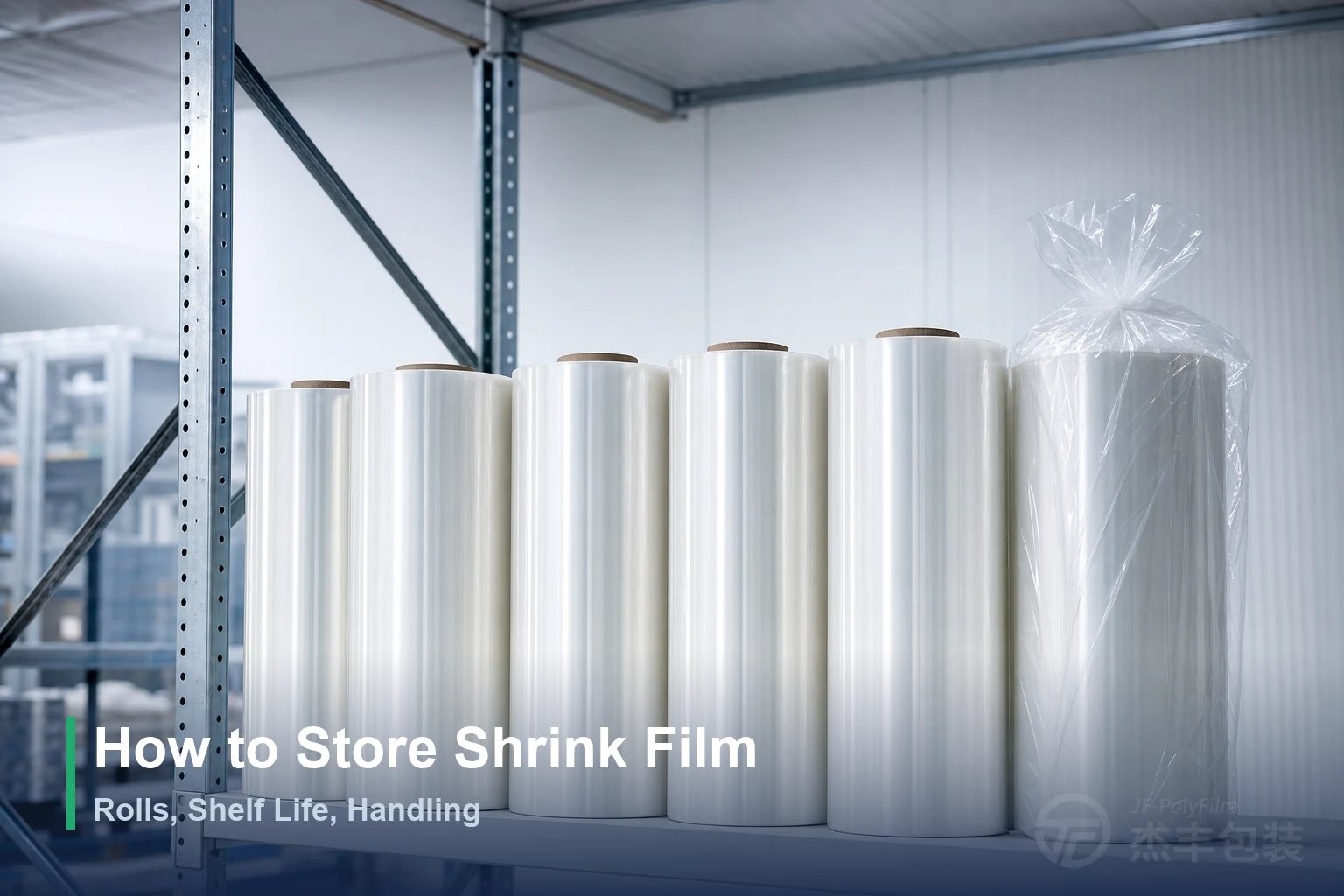
How to Store Shrink Film: Rolls, Shelf Life, Handling
What the 10–30°C, 12-month storage window actually protects, how to stand rolls so they don't flat-spot, and why film has to acclimate before it reaches the line.
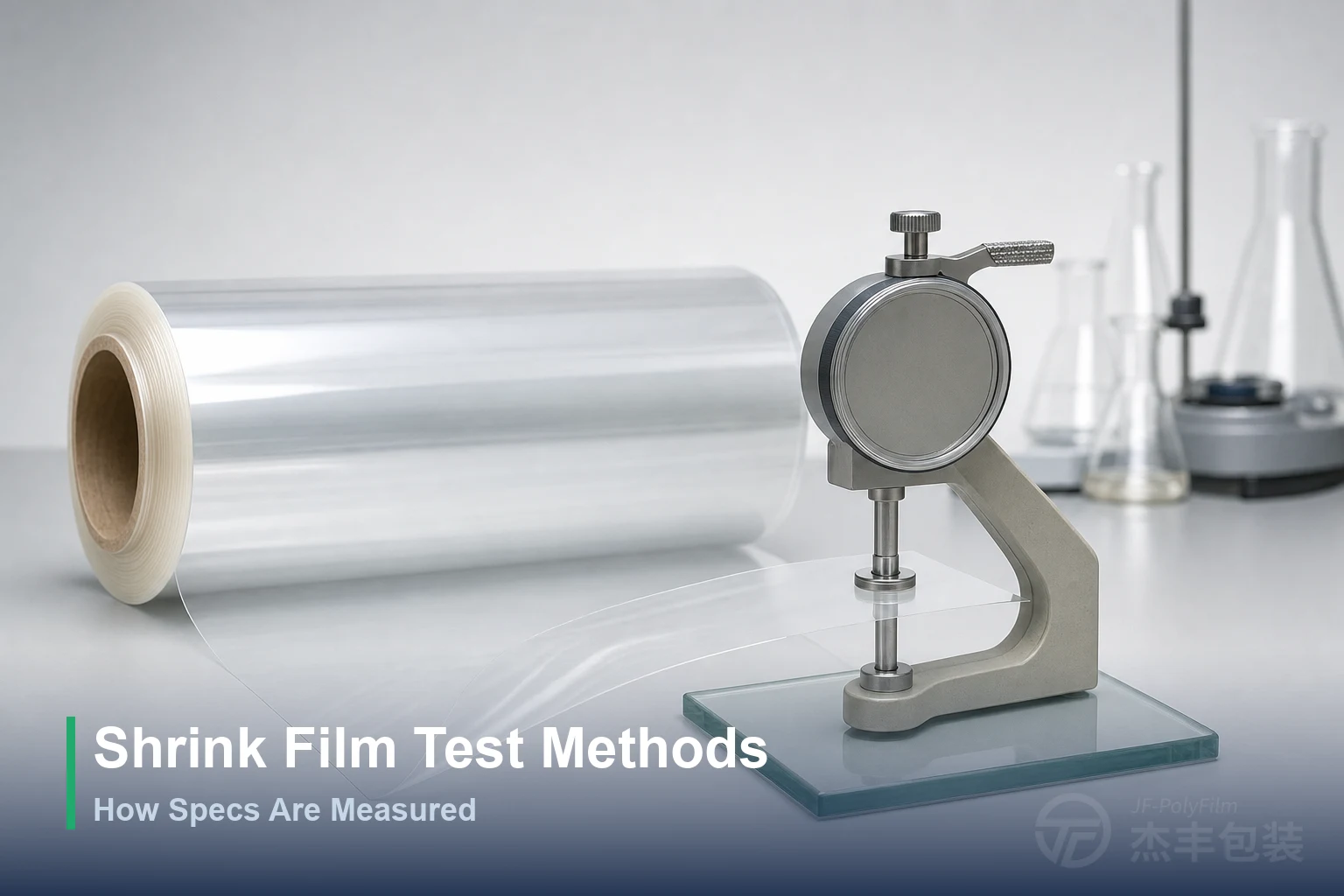
Shrink Film Test Methods: How Specs Are Measured
Every figure on a shrink film datasheet or COA traces back to a standard method. See which ASTM and ISO tests measure shrinkage, tensile, haze, and gauge, and how to read the report.
Need Expert Advice on Shrink Film?
Our technical team can help you choose the right film for your application.
Contact Us